On the classification of the order Glires / by Edward R. Alston.
- Edward Richard Alston
- Date:
- 1876
Licence: Public Domain Mark
Credit: On the classification of the order Glires / by Edward R. Alston. Source: Wellcome Collection.
Provider: This material has been provided by The Royal College of Surgeons of England. The original may be consulted at The Royal College of Surgeons of England.
3/40
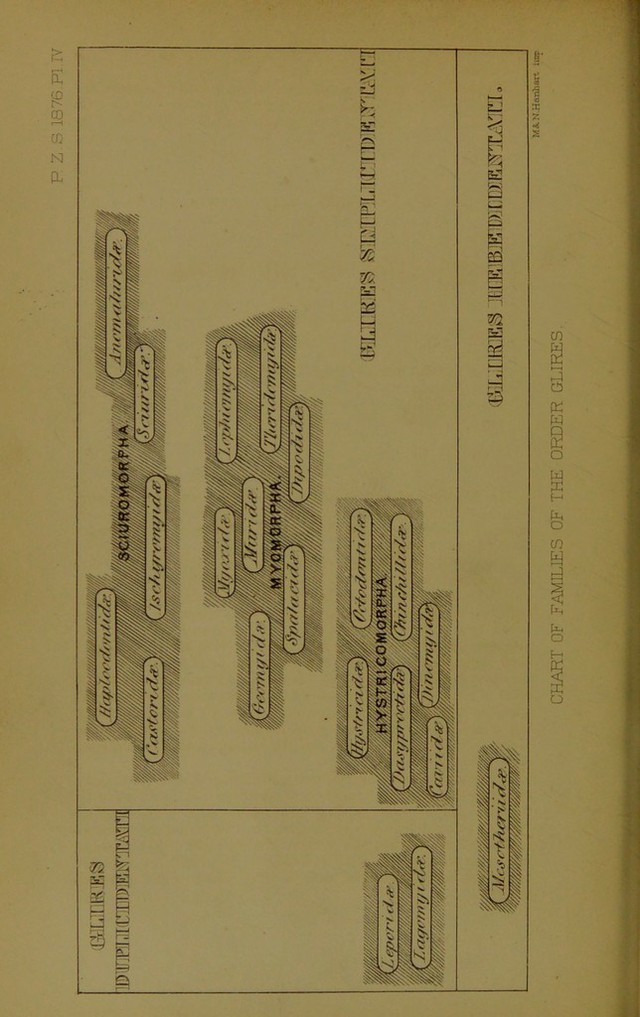
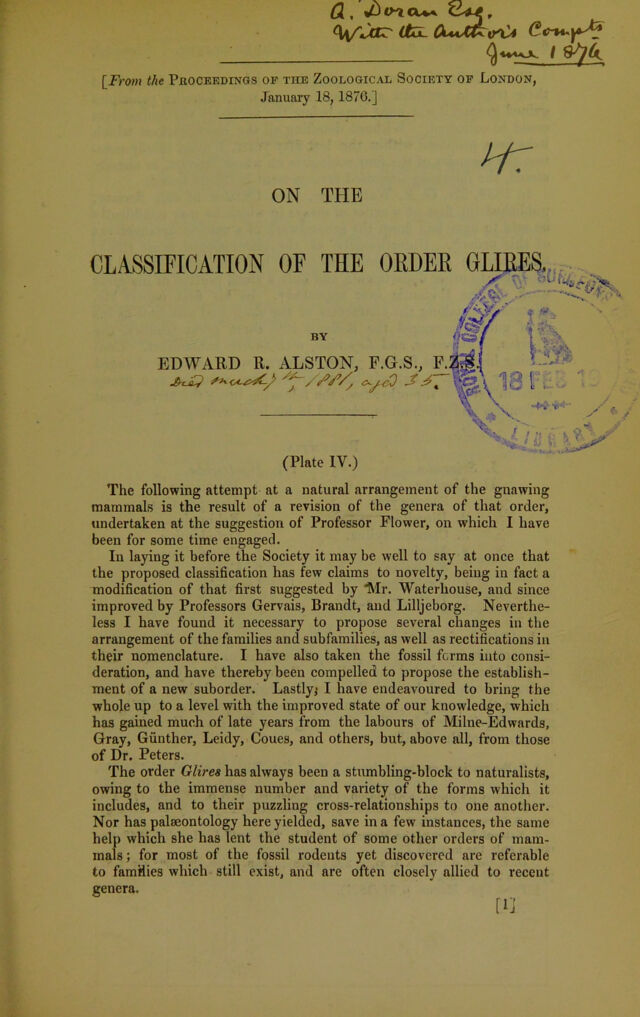
![a, *4r Qv^Jcrr 4feL (Vw-yl? ^ ■t^tAjk. I 8^4 [from </ie Pboceedings of the Zoological Society of London, January 18,1876.] Hr ON THE CLASSIFICATION OF THE OEDEK GLIEES. A ' 0f BY 0(£3i EDWARD R. ALSTON, F.G.S., F.lfa|| */<o 181: _ \ \ ”*■*- y (Plate IV.) •421a The following attempt at a natural arrangement of the gnawing mammals is the result of a revision of the genera of that order, undertaken at the suggestion of Professor Flower, on which I have been for some time engaged. In laying it before the Society it may be well to say at once that the proposed classification has few claims to novelty, being in fact a modification of that first suggested by “Mr. Waterhouse, and since improved by Professors Gervais, Brandt, and Lilljeborg. Neverthe- less I have found it necessary to propose several changes in the arrangement of the families and subfamilies, as well as rectifications in their nomenclature. I have also taken the fossil forms into consi- deration, and have thereby been compelled to propose the establish- ment of a new suborder. Lastly,* I have endeavoured to bring the whole up to a level with the improved state of our knowledge, which has gained much of late years from the labours of Milne-Edwards, Gray, Gunther, Leidy, Coues, and others, but, above all, from those of Dr. Peters. The order Glires has always been a stumbling-block to naturalists, owing to the immense number and variety of the forms which it includes, and to their puzzling cross-relationships to one another. Nor has palaeontology here yielded, save in a few instances, the same help which she has lent the student of some other orders of mam- mals ; for most of the fossil rodents yet discovered are referable to families which still exist, and are often closely allied to recent genera.](https://iiif.wellcomecollection.org/image/b22455334_0005.jp2/full/800%2C/0/default.jpg)