On the classification of the order Glires / by Edward R. Alston.
- Edward Richard Alston
- Date:
- 1876
Licence: Public Domain Mark
Credit: On the classification of the order Glires / by Edward R. Alston. Source: Wellcome Collection.
Provider: This material has been provided by The Royal College of Surgeons of England. The original may be consulted at The Royal College of Surgeons of England.
39/40 page 97
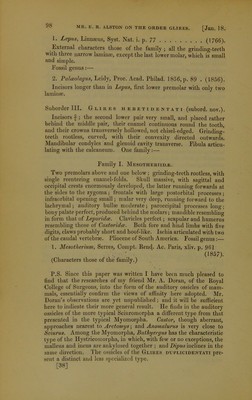
![3. Hydrochoerus, Brisson, Rfcgn. An. p. 116 (1756). Body massive; limbs moderate ; muzzle very blunt; eyes and ears small; tail obsolete; hair coarse and sparse; all the feet fully webbed. Skull massive; malar very deep; palate produced behind the last molar; incisive foramina short; paroccipital processes very large and long. Upper incisors grooved in front; upper grinding-teeth each with two lobes, united only by cement, except the third molar, which has twelve narrow transverse plates ; lower premolar and first molar with three narrow lobes, the second and third with four. Suborder II. Glires duplicidentati. Incisorsat birth ; the outer upper incisors soon lost; the next pair very small, placed directly behind the large middle pair ; their enamel continuous round the tooth, but much thinner behind. Skull with the optic foramina confluent, with no true alisphenoid canal; incisive foramina usually confluent; bony palate reduced to a bridge between the alveolar borders. Fibula ankylosed to tibia below, and articulating with the calcaneum. Testes permanently external; no vesicular glands. Two families :— Family I. Lagomyidal. Either one or two premolars above and below; grinding-teeth rootless, with transverse enamel-folds dividing them into lobes. Skull depressed ; frontals contracted, with no postorbital processes; facial surface of maxillary with a single perforation ; posterior angle of malar produced almost to the auditory meatus ; basisplienoid not perforate, nor separated by a fissure from the vomer ; coronoid pro- cess in the form of a tubercle. Clavicles complete. Ears short. Hind limbs not markedly elongated. No external tail. Palsearctic and Nearctic. Recent genus :— 1. Layomys, G. Cuvier, Tabl. Elem. de l’Hist. Nat. p. 132 (1/98). External characters those of the family ; two premolars above and below. Fossil genus:— 2. Titanomys, Von Meyer, Jahrb. fur Miueralog. 1843, p. 393 (1834). One premolar only, both above and below. Family II. Leporidal. Three premolars above, and two below ; grinding-teeth as in last family. Skull compressed; frontals with large wing-shaped post- orbital processes ; facial portion of maxillaries miuutely reticulated ; basisplienoid with a median perforation and separated by a fissure from the vomer ; coronoid process represented by a thin ridge of bone. Clavicles imperfect. Ears anti bind limbs elongated. Tail short, bushy, recurved. Cosmopolitan (except Australasian region). Re- cent genus:— [37]](https://iiif.wellcomecollection.org/image/b22455334_0041.jp2/full/800%2C/0/default.jpg)