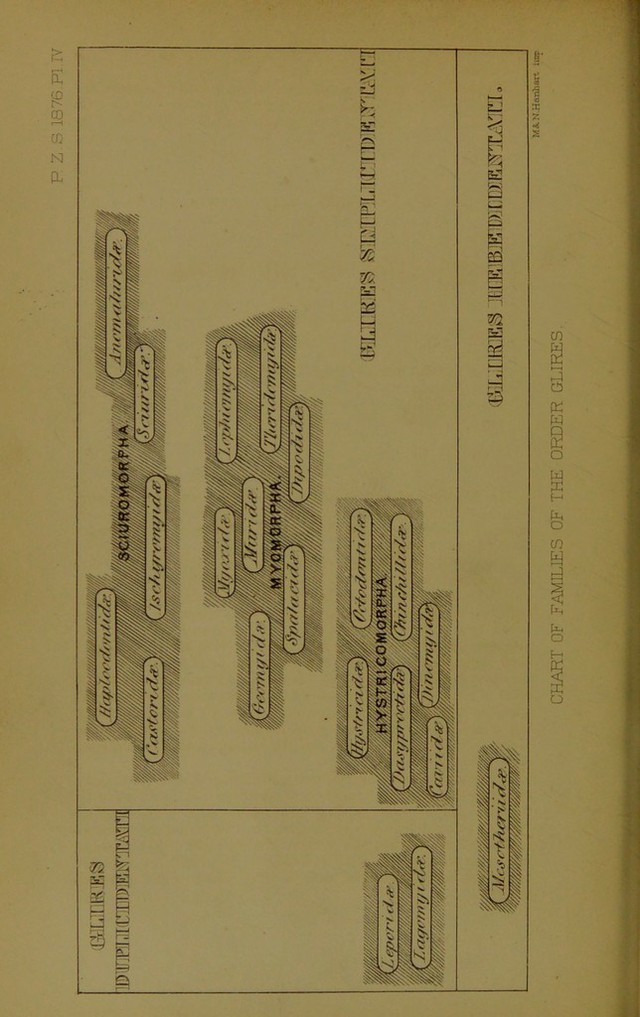
On the classification of the order Glires / by Edward R. Alston.
- Edward Richard Alston
- Date:
- 1876
Licence: Public Domain Mark
Credit: On the classification of the order Glires / by Edward R. Alston. Source: Wellcome Collection.
Provider: This material has been provided by The Royal College of Surgeons of England. The original may be consulted at The Royal College of Surgeons of England.
4/40 page 62
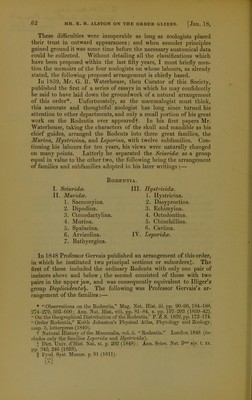
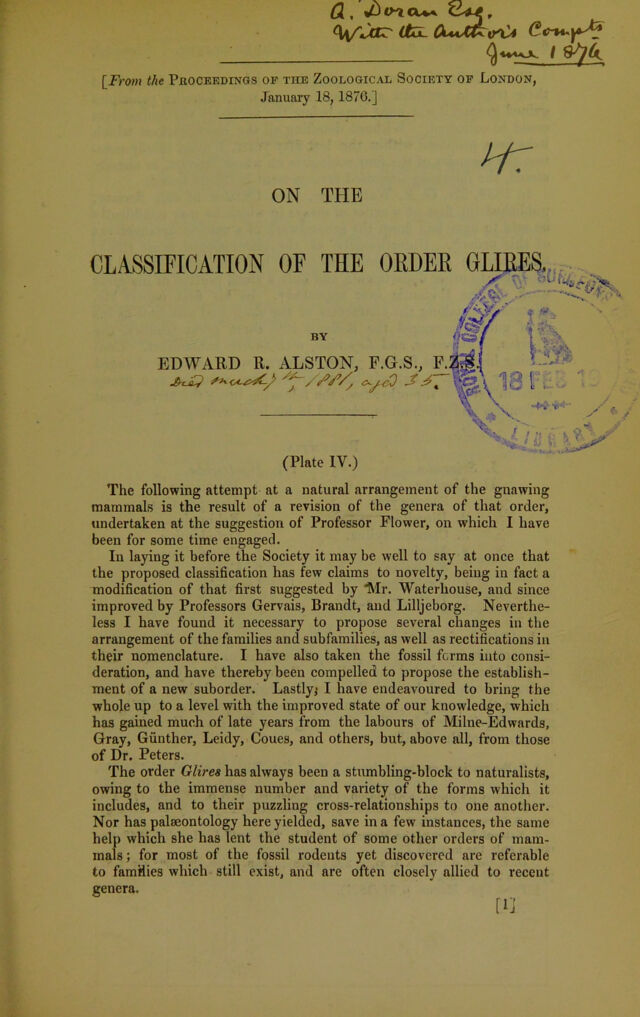
![These difficulties were insuperable as long as zoologists placed their trust in outward appearances; and when sounder principles gained ground it was some time before the necessary anatomical data could he collected. Without detailing all the classifications which have been proposed within the last fifty years, I must briefly men- tion the memoirs of the four zoologists on whose labours, as already stated, the following proposed arrangement is chiefly based. In 1839, Mr. G. R. Waterhouse, then Curator of this Society, published the first of a series of essays in which he may confidently he said to have laid down the groundwork of a natural arrangement of this order* * * §. Unfortunately, as the mammalogist must think, this accurate and thoughtful zoologist has long since turned his attention to other departments, and only a small portion of his great work on the Rodentia ever appearedf. In his first papers Mr. Waterhouse, taking the characters of the skull and mandible as his chief guides, arranged the Rodents into three great families, the Murina, Hystricina, and Leporina, with twelve subfamilies. Con- tinuing his labours for ten years, his views wTere naturally changed on many points. Latterly he separated the Sciurida as a group equal in value to the other two, the following being the arrangement of families and subfamilies adopted in his later writings :— Rodentia. I. Sciuridee. II. Muridce. 1. Saccomyina. 2. Dipodina. 3. Ctenodactylina. 4. Murina. 5. Spalacina. 6. Arvicolina. 7. Bathyergina. III. Ilystricidce. 1. Hystricina. 2. Dasyproctina 3. Echimyina. 4. Octodontina. 5. Chinchillina. 6. Caviina. IV. Leporidce. In 1848 Professor Gervais published an arrangement of this order, in which he instituted two principal sections or subordersj. The first of these included the ordinary Rodents writh only one pair of incisors above and below ; the second consisted of those with two pairs in the upper jaw, and was consequently equivalent to Illiger’s group Duplicidenta§. The following was Professor Gervais’s ar- rangement of the families:— * “ Observations on the Rodentia,” Mag. Nat. Hist. iii. pp. 90-96,184-188, 274-279, 593-600; Ann. Nat. Hist. viii. pp. 81-84, s. pp. 197-203 (1839-12). “ On the Geographical Distribution of the Rodentia,” P. Z. S. 1839, pp. 172-174. “ Order Rodentia,” Keith Johnston’s Physical Atlas, Phytology and Zoology, map. 5, letterpress (1849). t Natural History of the Mammalia, vol. ii. “Rodentia.” London 1848 (in- cludes only the families Leporidce and Hystricidce). t Diet. Univ. d’Hist. Nat. xi. p. 202 (1848); Ann. Seien. Nat. 3me s£r. t,. xx. pp. 245, 246 (1853). § Prod. Syst. Mamm. p. 91 (1811). [2]](https://iiif.wellcomecollection.org/image/b22455334_0006.jp2/full/800%2C/0/default.jpg)