On the classification of the order Glires / by Edward R. Alston.
- Edward Richard Alston
- Date:
- 1876
Licence: Public Domain Mark
Credit: On the classification of the order Glires / by Edward R. Alston. Source: Wellcome Collection.
Provider: This material has been provided by The Royal College of Surgeons of England. The original may be consulted at The Royal College of Surgeons of England.
7/40 page 65
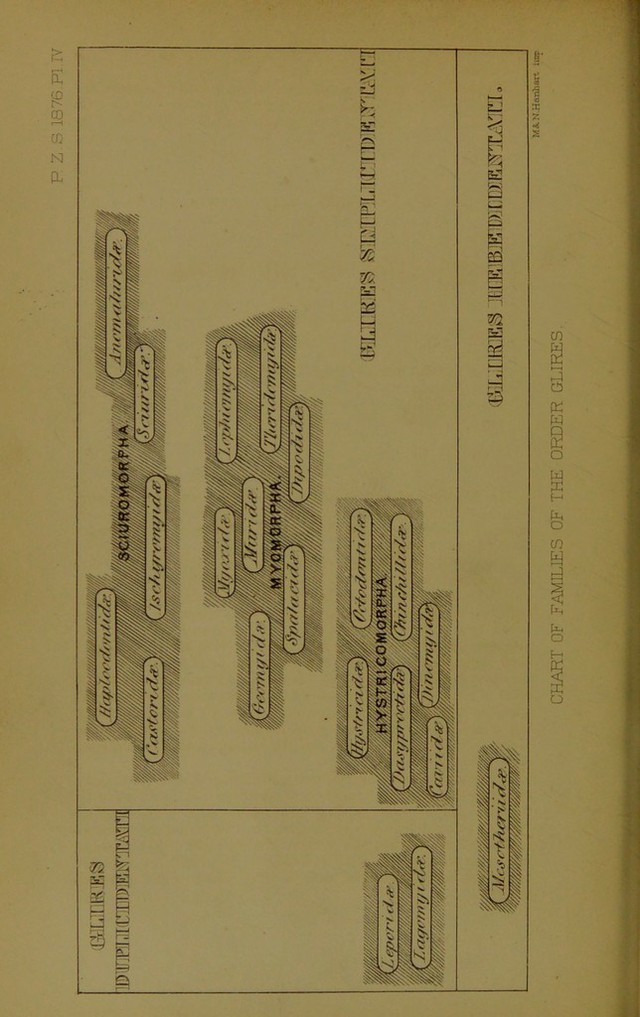
![here claimed for all the families and subfamilies. Such is the variety of the extent of differentiation that it appears to me that no Procrus- tean standard can be applied. Either we must load our memories with tribes, legions, cohorts, series, superfamilies, &c., or we must be content with divisions pretending only to an approximate equality of value. General Remarks. The first suborder of Rodents, Glires Simplicidentati, con- tains an enormous majority of both the recent and extinct forms, and is at once proved by its dentition to be the most highly specialized division of the order. There is only one pair of incisors above and below at all ages ; and their enamel is restricted to their front surface. In the skull, the incisive foramina are moderate and separate, the optic foramina are very rarely confluent, aud there is an alisplienoid canal*. The fibula is either ankylosed below to the tibia or free, and does not articulate with the ealcanium. Vesicular glands are present; and the testes are usually abdominal, only temporarily de- scending into the scrotal pouchesf. Of this suborder the first section, Sciuromorpha, has for con- stant characters the combination of a peculiar form of mandible with Mandible of Arctomys marmotta. the persistence of the fibula as a distinct bone throughout life. The former character at once separates it from the Hystricomorplia, the latter from the Myomorpha. In the mandible the angular portion springs from the lower edge of the bony covering of the inferior incisor, not from its outer side; and its outline is more or less rounded. * Cf. Tumor, P. Z. S. 1848, p. 65. t Cf. Owen, Anat. of Vert. iii. p. 649. [5]](https://iiif.wellcomecollection.org/image/b22455334_0009.jp2/full/800%2C/0/default.jpg)