A treatise on physiology applied to pathology / By F.J.V. Broussais ... Translated from the French, by John Bell ... and R. La Roche.
- François-Joseph-Victor Broussais
- Date:
- 1826
Licence: Public Domain Mark
Credit: A treatise on physiology applied to pathology / By F.J.V. Broussais ... Translated from the French, by John Bell ... and R. La Roche. Source: Wellcome Collection.
80/576 page 72
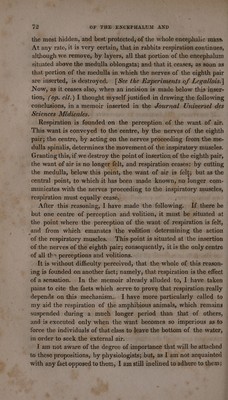
![the most hidden, and best protected, of the whole encephalic mass, At any rate, it is very certain, that in rabbits respiration continues, although we remove, by layers, all that portion of the encephalum situated above the medulla oblongata; and that it ceases, as soon as that portion of the medulla in which the nerves of the eighth pair are inserted, is destroyed. [See the Experiments of Legallois.] Now, as it ceases also, when an incision is made below this inser- tion, (op. cit.) I thought myself justified in drawing the following conclusions, in a memoir inserted in the Journal Universel des Sciences Médicales. Respiration is founded on the sani té of the want of air. This want is conveyed to the centre, by the nerves of the eighth pair; the centre, by acting on the nerves proceeding from the me- dulla spinalis, determines the movement:of the inspiratory muscles. Granting this, if we destroy the point of insertion of the eighth pair, the want of air is no longer felt, and respiration ceases: by eutting the medulla, below this point, the want of air is felt; but as the central point, to which it has been made known, no longer com- municates with the nerves proceeding to the inspiratory muscles, respiration must equally cease. After this reasoning, I have made the following. If there be but one centre of perception and volition, it must be situated at the point where the pereeption of the want of respiration is felt, and from which emanates the volition determining the action of the respiratory muscles. This point is situated at the insertion of the nerves of the eighth pair; consequently, it is the a centre of all the perceptions and volitions. It is without difficulty perceived, that the “he of this reason- ing is founded on another fact; namely, that respiration is the effect of a sensation. In the memoir already alluded to, I have taken pains to cite the facts which serve to prove that respiration really depends on this mechanism... I have more particularly called to my aid the respiration of the amphibious animals, which remains suspended during a much longer period than that of others, and is executed only when the want becomes so imperious as to force the individuals of that class to leave the bottom of the Shani in order to seek the external air. - Iam not aware of the degree of importance that will be attached _to these propositions, by physiologists; but, as I am not acquainted with any fact opposed to them, I am still inclined to adhere to them;](https://iiif.wellcomecollection.org/image/b33092618_0080.jp2/full/800%2C/0/default.jpg)