A system of instruction in quantitative chemical analysis / by C. Remigius Fresenius.
- Fresenius, C. Remigius, 1818-1897. Anleitung zur qualitativen chemischen Analyse. English
- Date:
- 1854
Licence: Public Domain Mark
Credit: A system of instruction in quantitative chemical analysis / by C. Remigius Fresenius. Source: Wellcome Collection.
557/680 page 537
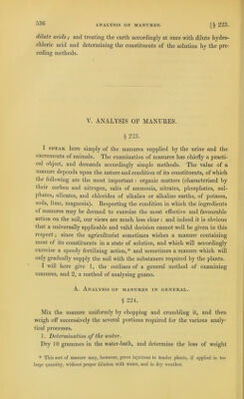
![(§ 18). It is rarely necessary to make a correction on account of the earbonate of ammonia whicli escapes with the water.* 2. jDetermination of the total amount of fixed constituents. Incinerate at a gentle heat, a weighed portion of the residue left in 1, in a platinum dish, or in a large platinum crucible placed in an oblique position, and weigh the ash. 3. Determination of the constituents soluble in water, and also of those insoluble in water. Digest 10 grammes of the fresh manure with 300 c. c. of water, pass the liquid through a weighed filter (§ 33), wash the residue, dry at 212° and weigh. The weight found expresses the total quantity of the sub- stances insoluble in water, and the difference gives the amount of the soluble constituents. Incinerate now the insoluble residue, and weigh the ash ; the weight of the ash expresses the total amount of the fixed consti- tuents contained in the insoluble part, and from the difference between this and the ash] in 2, you learn the total amount of fixed constituents contained in the soluble part. 4. Separate determination of the several fixed constituents. Dry a larger portion of the manure and treat it strictly by one of the methods given for the preparation and analysis of the ashes of plants. 5. Determination of the total amount of ammonia. Treat a weighed portion of the manure by Schlösing's method (§ 78, 3)f 6. Determination of the total amount of nitrogen. Moisten a weighed portion of the manure with a dilute solution of oxalic acid in sufficient quantity to impart a feebly acid reaction; dry, and determine the nitrogen either in the entire mass or in a weighed portion of it according to the directions given in § 155. If you deduct from the total amount of nitrogen so found the quantity corresponding to the ammonia and the nitric acid, you learn the quantity of nitrogen con- tained in the organic substances. It is generally sufficient, however, to total amount of the nitrogen. 7. Determination of the total amount of carbon. Treat a portion of the dried residue of 1 by the process of elementary analysis. If the dried manure contains carbonates, determine the carbonic acid in a separate portion. Deduct this from the total amount obtained in the elementary analysis : the difference shows the quantity of carbonic acid formed from organic substances. * The determination of the earbonate of ammonia may, if desirable, be effected most simply by boiling a portion of the manure for some time with water in a capacious retort, and collecting the vapors passing over in a receiver containing a definite quantity of sulphuric acid of known strength (compare § 177, 8, Boussingault's method.) f If the quantity of ammonia is only small, a weaker sulphuric acid will answer better than that prepared according to the directions of § 78,3; it is therefore advisable in such cases to substitute for the latter the acid prepared according to the directions of § 182, and which contains in 10 c. c. 0'4 grm. of sulphuric acid.](https://iiif.wellcomecollection.org/image/b28133742_0557.jp2/full/800%2C/0/default.jpg)