Volume 1
A dictionary of the Chinese language, in three parts / By the Rev. Robert Morrison.
- Robert Morrison
- Date:
- 1815-1823
Licence: Public Domain Mark
Credit: A dictionary of the Chinese language, in three parts / By the Rev. Robert Morrison. Source: Wellcome Collection.
26/974
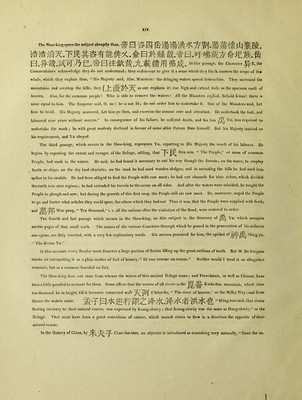
![X1Y. TkShwkinsfthMubjMabmptly ttm,,帝日咨四岳湯湯洪水方割.蕩•蕩懷山裏陵. 诰浩滔天•下民其咨有能俾乂 •僉曰於鰥哉•帝曰•吁嗍哉方命圯族•吿 曰•异哉•試可乃已•帝曰往歎哉.九載績用弗成• Inthis Passa#,th6 Chara<:tei■异E,th6 Commentators acknowledge they do not understand; they endeavour to giye it a sense which they think answers the scope of th# whole, which they explain thus, <cHis Majesty said, Alas, Ministers! the deluging waters spread destruction. They surround the mountains, and overtop the hills; they ^ as one explains it) rise hi^h and extend wide as the spacious vault of heaven. Alas, for tlie common people! Who is able to remove the waters ? All the Ministers rejilied, Behold Kwan! there is none equal to hinu The Emperor said, O, no t be is not fit; do not order him to undertake it. One of the Ministers said, Let him be tried‘ His Majesty answered, Let him then, and exercise the utmost care and attention. He undertook the task, and laboured nine years without success.” In consequence of his failure, he suffered death, and his Son Yu, was required to undertake the work ; he with great modesty declined in favour of some abler Person than himself. But liis Majesty insisted or his requirement, and Yit obeyed. The third passage, which occurs in the Shoo-kingr represents Yu, reporting to His Majesty the result of his labours. Hr begins by repeating tke extent and ravages of the Deluge, adding, that 下民 Hea min, “ The People,” or mass of common People, had sunk in tlie waters. He said, he had found it necessary to cut his way though the forests ; on the waterr to eraploj boats or ships; on the dry land chariots; on the mud he had used wooden sledges^ and in ascending the hills he had used iron spikes in his sandals. He had been obliged to feed the People with. raw. meat;, he had cut channels for nine rirers, which divided the earth into nine regions ; he had extended his travels to the ocean on all sides. And after the waters were subsided, he taught the People to plough and sow; bat during the growth of this first crop, the People still ate raw meat. He, moreover, urged the People to go and barter what articles they eoul<l spare, for others which they had not Thus it wa^ that the People w©re supplied with food^ and Wan pangr u Ten thousand,^ i. e. all the nations after the visitation of the flood, were restored to order. The fourth and last passage which occurs in the Shoo-king, on this subject is, the Itinerary of Yu, ^\hich occupies twelve pages of that small work. The names of the various Countries through which he passed in the prosecution of his arduous enterprise, are duly inserted, with a very few explanatory words. His success procured for hira,the epithet of 刀冲 Shii]g-yn, “ The divine Yu.’, In this account, every Reader must discover a large portion of fiction filling up the great outlines of truth. But M. De Guignes insists on interpreting it as a plain matter of fact of history, ^ Et non comme un roraan.?, Neither would I treat it as altogether romance, but as a romance founded on fact. The Shoo-king does not state from whence the waters of this ancient Deluge came; and Frenchmen, as well as Chinese, hare been a little puzzled to account for them. Some affirm that the source of all rivers is the Kwan-lun mountain, which rises ten thousand Le in height, till it becomes connected wit^1 T^een-ho, a The river of heaven/' or the Milky Way ; and from thence the waters came. ]^子円水逆^亍謂之争,水.)伞水考~淨^水也^ '^Mang-tsze said, that river* flowing contrary to their natural course, was expressed by Keang-shwiiy 5 that Keang-shwiiy was the same as Hung-sliwiiy,’’ or the Deluge. That must haye been a great conTulsion of nature, which caused rivers to flow in a direction the opposite of their natural course. In the History of China, by Choo-foo4szc? an objector is introduced as remarking rery naturally, u Since the im-](https://iiif.wellcomecollection.org/image/b2201178x_0001_0026.jp2/full/800%2C/0/default.jpg)