Volume 1
A dictionary of the Chinese language, in three parts / By the Rev. Robert Morrison.
- Robert Morrison
- Date:
- 1815-1823
Licence: Public Domain Mark
Credit: A dictionary of the Chinese language, in three parts / By the Rev. Robert Morrison. Source: Wellcome Collection.
60/974 page 22
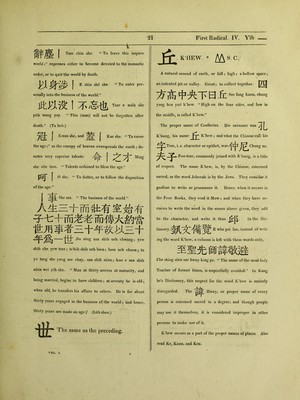
![.— I San k'hew. Three places said to be inhabited —仙 Seen, or men of the hills, who have risen superior to humanity. 前高後下曰薦丨Ts&nka<)uh(mh6a yue maou k'hew. “ High before, and low behind, is called maou k’hew.” 桑門爲息心比丨爲行乞 Sang mun wei seih sin ; pe k'hew wei hin^ keih. ‘‘ Sang mun (the priests of Taou) cease from the cares of the world ; Pe k’hew (the priests of Fuh) go about begging.” 世尊 She tsun. “ The honorable of the agei. e. S〇d佛職. I Yuen k5hew. An eminence on which they the sacrifice to Heaven. | Fang k'hew. A lower place on which they sacrifice to the Earth. 四井爲&四邑爲丨丨十 六井也 Sze tsing wei yih, sze ylh wei kshew; k'hew shih liih tsing yay, “ Four tsing (or portions of land divided » like the character Tsing) make a yih, four ylh make a k?hew; hence a k’hew is sixteen tsing。,’ 丨里 K’hew le. Ten families of different surnames forming a village of a hundred persons. Originally written P化,“North,” with a line; the line representing the earth. It denotes people living on the south side of a hill. (Shwo wan.) 来 The same as the preceding. They say that it represents two men standing on the ground. 让 ping. ^jr. h. 十榦名之一 Shih kan ming che ylh. u Name of one of the Shih kan,’’ or characters used in the division of time. 青丙 Tsing ping. Denotes heaven. 實 Tsing woo. Denotes earth. I Ta ping. The name of a deity. Ping is used as a surname. Sometimes denotes the tail of a fish. 从一入门一者陽门者門 也 Tsung yih jiih keung, yih chay yang, keung chay mun yay. u Formed from —- Yih, entering |~J Keung* One is the yang,keung the door of the universe.”(Shw6 wan.) There is nothing more unsatisfactory and unintelligible about the Chinese, than their theories of the formation of the world. 西 Characters formed by Five Strokes. T HEEN. * Supposed to represent the tongue put forth out of the mouth to touch the upper stroke. To lick or take up with the tongue. Now obsolete. 館 T'heen, is used in the same sense. Also read Theen. j^SHING, ]; Ching & Ching.晶S.C. From two hands supporting the emblem of ai seal, or that which in ancient times answered the purpose of the seal of the present day. Below is placed a hill, to denote bearing high the ensign of authority.](https://iiif.wellcomecollection.org/image/b2201178x_0001_0060.jp2/full/800%2C/0/default.jpg)