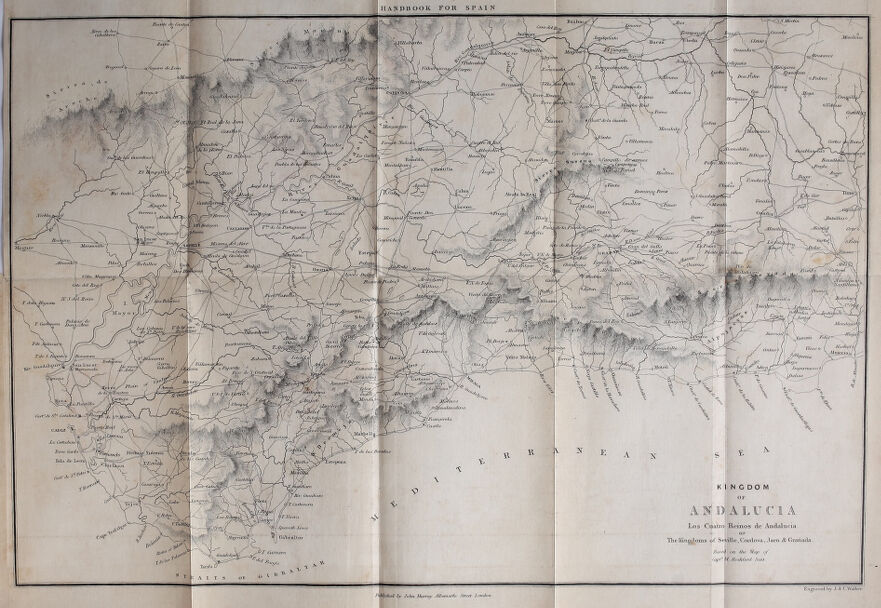
Copy 1, Volume 1
A hand-book for travellers in Spain, and readers at home. Describing the country and cities, the natives and their manners, the antiquities, religion, legends, fine arts, literature, sports, and gastronomy : with notices on Spanish history.
- John Murray
- Date:
- 1845
Licence: Public Domain Mark
Credit: A hand-book for travellers in Spain, and readers at home. Describing the country and cities, the natives and their manners, the antiquities, religion, legends, fine arts, literature, sports, and gastronomy : with notices on Spanish history. Source: Wellcome Collection.
571/582 (page 553)
![everything; they kept horses in the church, ami made the Emperor's room a place for silk-worms. Recent se- questrations have again destroyed what the poor monks had partially restored, and chaos is come again. Never again will it be the lot of tra- veller to be welcomed, like ourselves, by these worthy men, to whom news and astrangerfrom the real living world was a godsend. The day was passed in sauntering about the ruined build- ings and gardens, with the goodnatured garrulous brotherhood: at nightfall supper was laid for all the monks to- gether at a long board, but the prior and procurador had a small table set apart in an alcove, where, “ bidden to a spare but cheerful meal, I sat an honoured guest;’’ as the windows were thrown wide open, to admit the cool thyme- scented breeze, the eye in the clear evening swept over the boundless val- ley, and the nightingales sang sweetly in the neglected orange garden, to the bright stars reflected like diamonds in the black tank below us; how often had Charles looked out on a stilly eve on this selfsame and unchanged scene where he alone was now wanting! When supper was done, 1 shook hand all round with my kind hosts, and went to bed, in the chamber where the em- peror breathed his last. All was soon silent, and the spirit of the mighty dead ruled again in his last home ; but no Charles disturbed the deep slumber of a weary insignificant stran- ger; long ere daybreak next morning I was awakened by a pale monk, ami summoned to the early mass, which the prior in his forethought had ordered. The chapel was imperfectly lighted, and the small congiegation consisted of the monk, my sunburnt muleteer, and a stray beggar, who, like myself, had been sheltered in the convent; when the service was concluded, all bowed a last, farewell to the altar on which the dying glance of Charles had been fixed, and departed in peace; the morning was grey and the mountain air keen, nor was it until the sun had risen high that the carol of the light-hearted maidens dispelled the cowl, and relaid the ghost of Charles in the dim pages of history. ROUTE LX.—PLACENCIA TO SALA- MANCA. Villar 3 Aldea Nneva . . . 3 .. 6 Banos. ..... 2 s Bejar 2 .. lo Pedro mingo . . . 2 .. 12 Fuente Roble . . . 2 .. 14 Monte Rubio . . . 4 .. ]8 Salamanca .... 4 .. 22 This is the direct road, but by no means the one to take : at Aldea Nueva the Roman road from Merida is crossed, and remains of its pavemen-tand aban- doned bridges everywhere may be traced. Baftos is so called from its hot sulphur baths. This town is beau- tifully situated, with its pretfy river Ambros; the belfry of the S- Maria is tine; the wines excellent; about 1 L. up is the Puerto or pass in the Sierra, which divides Estremadura from Old Castile; here Sir Robert Wilson with a few undisciplined Por- tuguese made a bold stand against the French coming down from Gallicia and Oporto, while the Spanish troops abandoned the position without firing a shot. Thus Soult was enabled to reach the rear of the English at Tala- vera, which he never could have done had Cuesta attended to the Duke's urgent request to man these impreg- nable passes. The obstinate block- head only sent a force the very day the French were at Bejar; but manana is the curse of Iberia, and such are the Socorros de Espana, tarde o nunca, “ late or never.” Bejar is another of the steep fresh towns of the Sierra : pop. about 8000. Its situation is extremely picturesque, andthe river Cuerpo delHornbre fertilizes the environs. The alcazar of the Duque is a striking object, with a fine classical patio and fountain ; the views from it are splendid. It was gutted by the French, when the pictures and remarkable armoury disappeared. Near Bejar, Feb. 20, 1813, Monsr- Foy re.](https://iiif.wellcomecollection.org/image/b28745619_0001_0571.jp2/full/800%2C/0/default.jpg)