Addresses delivered in the University of Glasgow at the opening and close of the medical session / by John Young, M.D., L.R.C.S., Professor of Natural History.
- John Young
- Date:
- 1884
Licence: Public Domain Mark
Credit: Addresses delivered in the University of Glasgow at the opening and close of the medical session / by John Young, M.D., L.R.C.S., Professor of Natural History. Source: Wellcome Collection.
Provider: This material has been provided by The University of Glasgow Library. The original may be consulted at The University of Glasgow Library.
6/66 (page 4)
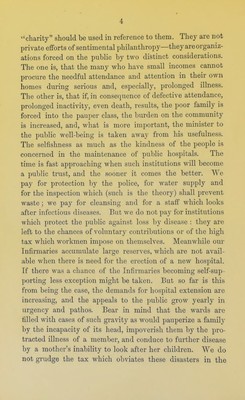
![charity should be used in reference to them. They are not private efforts of sentimental philanthropy—they are organiz- ations forced on the public by two distinct considerations. The one is, that the many who have small incomes cannot procure the needful attendance and attention in their own homes during serious and, especially, prolonged illness. The other is, that if, in consequence of defective attendance, prolonged inactivity, even death, results, the poor family is forced into the pauper class, the burden on the community is increased, and, what is more important, the minister to the public well-being is taken away from his usefulness. The selfishness as much as the kindness of the people is concerned in the maintenance of public hospitals. The time is fast approaching when such institutions will become a public trust, and the sooner it comes the better. NYc pay for protection by the police, for water supply and for the inspection Avhich (such is the theory) shall prevent waste; we pay for cleansing and for a staff which looks after infectious diseases. But we do not pay for institutions which protect the public against loss by disease : they are left to the chances of voluntary contributions or of the high tax which workmen impose on themselves. Meanwhile our Infirmaries accumulate large reserves, which are not avail- able when there is need for the erection of a new hospital. If there was a chance of the Infirmaries becoming self-sup- ])orting less exception might be taken. But so far is this from being the case, the demands for hospital extension are increasing, and the appeals to the public grow yearly in urgency and pathos. Bear in mind that the wards ai'o filled with cases of such gravity as would pauperize a family by the incapacity of its head, impoverish them by the pro- tracted illness of a member, and conduce to further disease by a mother's inability to look after her children. We do not grudge the tax which obviates these disasters in the](https://iiif.wellcomecollection.org/image/b21464212_0006.jp2/full/800%2C/0/default.jpg)