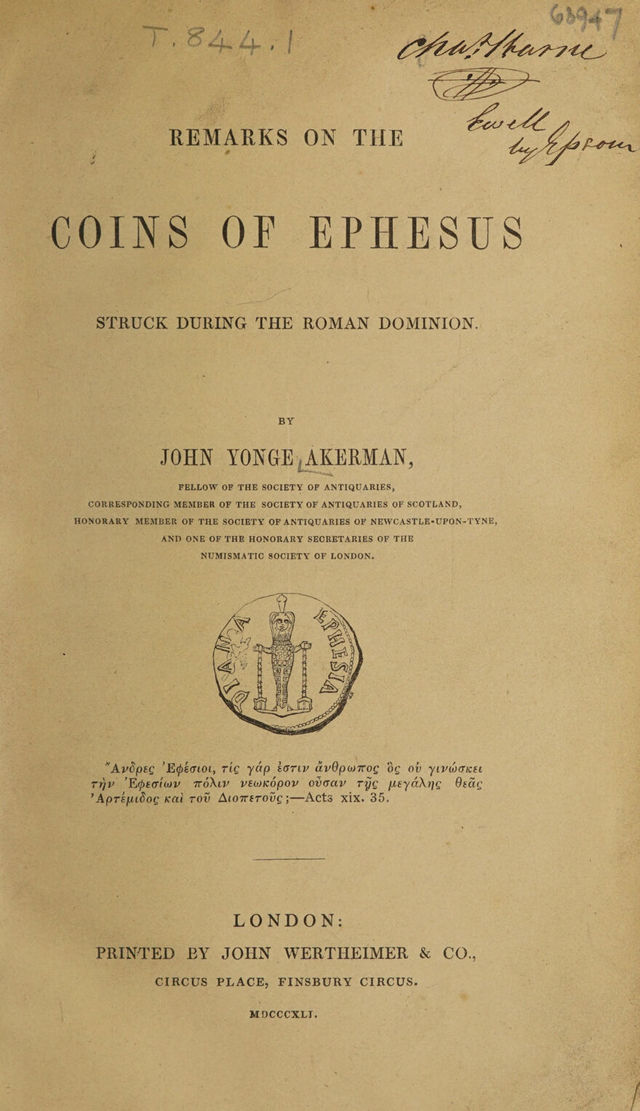
Remarks on the coins of Ephesus struck during the Roman dominion / By John Yonge Akerman.
- John Yonge Akerman
- Date:
- 1841
Licence: Public Domain Mark
Credit: Remarks on the coins of Ephesus struck during the Roman dominion / By John Yonge Akerman. Source: Wellcome Collection.
5/54 page 5
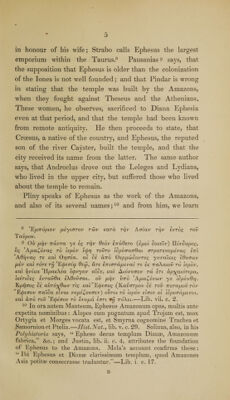
![in honour of his wife; Strabo calls Ephesus the largest emporium within the Taurus.8 9 Pausanias 9 says, that the supposition that Ephesus is older than the colonization of the Iones is not well founded; and that Pindar is wrong in stating that the temple was built by the Amazons, when they fought against Theseus and the Athenians. These women, he observes, sacrificed to Diana Ephesia even at that period, and that the temple had been known from remote antiquity. He then proceeds to state, that Croesus, a native of the country, and Ephesus, the reputed son of the river Cayster, built the temple, and that the city received its name from the latter. The same author says, that Androclus drove out the Leleges and Lydians, who lived in the upper city, but suffered those who lived about the temple to remain. Pliny speaks of Ephesus as the work of the Amazons, and also of its several names;10 and from him, we leant 8 ’E^tTroptov fiiyiGTOv tGjv Kara tj)v Acrtav ti)v evtoq tov T ctvpov. 9 Ov fillv 7ravra ye eg rrjy 0eor e~vQeto (epoi £ove7r) TUy^apog, og ’Afjci^ovac to tepov E(pj] tovto Icov&cicrdaL orpaTEVofiirac e~l ’A0/j rac re vat Orjiria. at £e d~o OsppwcoiTog yumtrte e&vvciv fiEV vat tote Trj ’E(psaia Oeu), are ETTiordfiEvcii te ex —aXaiov to lEpbr, vat TjvLKa 'HpavXea E<pvyov aicE, rat Aioyviroy ra etl ap-^aioTEpa, iXETLCEg h'Tavda kXSovcrai. ov pijv xnzo ’Apa^oriov ye icpvvdij. Kpijcrog ce avTO\6iov Tig vat E0ecroc (KavaTpov ce tov —otci/jov tov ’ E(pEcroy 7rat?a sivai yofii^ovaEv) ovtol to tepov eiaiv oi idpvacifjEyci, vat curb tov ’E^eerou to ovofici ecttl rij ttoXel.—Lib. vii. c. 2. 10 In ora autem Manteum, Ephesus Amazonum opus, nmltis ante expetita uominibus: Alopes cum pugnatum apud Trojam est, mox Ortygia et. Morges vocata est, et Smyrna cognomine Trachea et Samornionet Ptelia.—Hist.Xat., lib. v. c. 29. Soliuus, also, in his Polyhistoria says, “ Epheso decus templum Diana?, Amazonum fabriea, ike.; and Justin, lib. ii. c. 4, attributes the foundation of Ephesus to the Amazons. Mela’s account confirms these: “ Ibi Ephesus et Dianae clarissimum templum, quod Amazones Asia potitae consecrasse traduntur.—Lib. i c. 17. B](https://iiif.wellcomecollection.org/image/b31871896_0005.jp2/full/800%2C/0/default.jpg)