Chemical examination of cascara bark / by H.A.D. Jowett.
- Jowett, Hooper Albert Dickinson, 1870-1936.
- Date:
- [1904]
Licence: Attribution 4.0 International (CC BY 4.0)
Credit: Chemical examination of cascara bark / by H.A.D. Jowett. Source: Wellcome Collection.
Provider: This material has been provided by The Royal College of Surgeons of England. The original may be consulted at The Royal College of Surgeons of England.
13/28 page 11
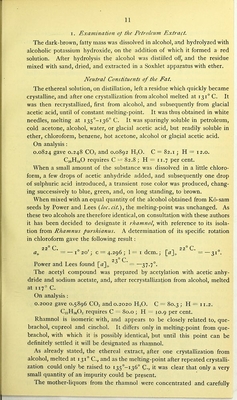
![I. Exatnination oj the Petroleum Extract. The dark-brown, fatty mass was dissolved in alcohol, and hydrolyzed with alcoholic potassium hydroxide, on the addition of which it formed a red solution. After hydrolysis the alcohol was distilled off, and the residue mixed with sand, dried, and extracted in a Soxhlet apparatus with ether. Neutral Constitue?its of the Eat. The ethereal solution, on distillation, left a residue which quickly became crystalline, and after one crystallization from alcohol melted at 131° C. It was then recrystallized, first from alcohol, and subsequently from glacial acetic acid, until of constant melting-point. It was thus obtained in white needles, melting at i35°-i36° C. It was sparingly soluble in petroleum, cold acetone, alcohol, water, or glacial acetic acid, but readily soluble in ether, chloroform, benzene, hot acetone, alcohol or glacial acetic acid. On analysis: 0.0824 gave 0.248 CO2 and 0.0892 H2O. C = 82.1; H = 12.0. C20H34O requires C — 82.8 ; H = ri.7 per cent. When a small amount of the substance was dissolved in a little chloro- form, a few drops of acetic anhydride added, and subsequently one drop of sulphuric acid introduced, a transient rose color was produced, chang- ing successively to blue, green, and, on long standing, to Drown. When mixed with an equal quantity of the alcohol obtained from K6-sam seeds by Power and Lees (loc.cit.), the melting-point was unchanged. As these two alcohols are therefore identical, on consultation with these authors it has been decided to designate it rhamnol, with reference to its isola- tion from Rhaninus purshianus. A determination of its specific rotation in chloroform gave the following result: 22 C. — I 4.296; 23° c. I dcm.; [«]„ C. = -31 Power and Lees found [a]„ = “37-7 The acetyl compound was prepared by acetylation with acetic anhy- dride and sodium acetate, and, after recrystallization from alcohol, melted at 117° C. On analysis : 0.2002 gave 0.5896 CO2 and 0.2020 H2O. C = 80.3 ; H = 11.2. C22H36O2 requires C = 80.0 ; H = io.9 per cent. Rhamnol is isomeric with, and appears to be closely related to, que- brachol, cupreol and cinchol. It differs only in melting-point from que- brachol, with which it is possibly identical, but until this point can be definitely settled it will be designated as rhamnol. As already stated, the ethereal extract, after one crystallization from alcohol, melted at 131° C., and as the melting-point after repeated crystalli- zation could only be raised to i35°-r36° C., it was clear that only a very small quantity of an impurity could be present. The mother-liquors from the rhamnol were concentrated and carefully](https://iiif.wellcomecollection.org/image/b22401787_0015.jp2/full/800%2C/0/default.jpg)