Annual report of the Director of Public Health for the Government of Bombay.
- Bombay (India : State). Public Health Department.
- Date:
- [1936]
Licence: Public Domain Mark
Credit: Annual report of the Director of Public Health for the Government of Bombay. Source: Wellcome Collection.
48/220 (page 28)
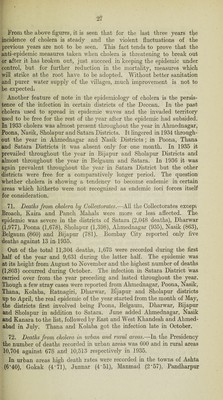
![(2'04), Islampur (1 • 96) and Yeola (1 * 49), and in rural areas in the talukas of Kalwan (6*09), Junnar (5’06), Hangal (4*37), Shirala (3*97), Walwa (3*82), Karajgi (3*40), Malsiras (3'33) and Karad (3'13). 73. Brief history of cholera epidemic by Registration Districts.—The heaviest incidence was in the Southern Registration District in which 7,096 deaths occurred ; the next came the Central Registration District with 3,860 deaths and the last was the Northern Registration District with 343 deaths only. Compared with the year preceding, the incidence of cholera in Southern Registration District was very high particularly in the districts of Satara, Dharwar and Sholapur. Belgaum and Bijapur came next in order of severity. Kanara had only 32 deaths on record. In Satara District cholera appeared in 17 out of 18 Registration Circles and was reported from 320 villages and towns. There were 4,650 attacks and 2,048 deaths. The intensity was the greatest from June to November. The infection in this district was continued since March 1935 and carried over into 1936. The rural circles of Karad, Walwa, Shirala, Tasgaon and Kore- gaon were badly affected. Among the town circles Ashta town reported the highest number of deaths. Next to Satara, Dharwar District was severely affected. 17 circles of Registration and 324 villages and towns were affected. A few stray cases occurred in January, March and May and the epidemic started in June and reached its climax in September. Havanur in Karajgi Taluka was the first village to report infection on 27th May 1936 where the infection was imported from Bellari District. The infection rapidly spread in several villages. Mundargi, Ranebennur, Gadag and Navalgund talukas were infected in June and Kalghatgi,. Hubli, Ron and Dharwar talukas in J uly. Dharwar town was respon¬ sible for infection in six villages in the taluka and Hubli town for infection in 3 villages of Hubli taluka. In Ron Taluka the Benni Nala' was the source of infection in 5 villages. In this district the talukas of Karajgi, Ranebennur, Dharwar, Hangal, Kod, Hubli and Gadag suffered heavily. In Sholapur District one case each was reported in January, March and May. The epidemic started in June and reached its climax in July. Ten circles of Registration and 231 villages reported infection. The talukas of Barsi, Madha, Malsiras, Pandharpur and Sangola were badly affected. Infection was reported in Pandharpur Taluka on 29th May. Arjunsond and Pandharpur town were infected on 29th and 31st May respectively. Sakat village in Barsi taluka was infected on 12th June 1936. Infection in nine other villages was traced to this village. Pandharpur town recorded 77 cases and 60 deaths during the year. In Belgaum District, 13 circles of Registration and 143 villages reported cholera infection. The disease started since May, Belwadi and Ambadgatti villages in Sampgaon taluka being first infected on 4th and 5th May respectively. Chikodi Taluka was also infected in May and Kanapur, Athani, Parasgad and Belgaum talukas in June. The talukas reporting high number of deaths were Chikodi, Gokak, Sampgaon and Parasgad. In Bijapur District cholera was reported from 12 circles of Registration and 166 villages. The talukas of Sindgi,] :](https://iiif.wellcomecollection.org/image/b31405320_0048.jp2/full/800%2C/0/default.jpg)