Annual report of the Director of Public Health for the Government of Bombay.
- Bombay (India : State). Public Health Department.
- Date:
- [1936]
Licence: Public Domain Mark
Credit: Annual report of the Director of Public Health for the Government of Bombay. Source: Wellcome Collection.
56/220 (page 34)
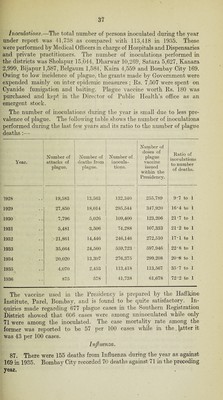
![The total number of deaths recorded in each year since 1911 is given Year. Number of deaths. Year. Number of deaths. 1911 97,248 1924 ‘ 9,092 1912 27,863 1925 V 12,551 1913 24,840 1926 9,839 1914 18,529 1927 4,075 1915 40,689 1928 13,563 1916 79,349 1929 18,014 1917 1,59,858 1930 5,026 1918 73,893 1931 3,506 1919 9,141 1932 • • • • 14,446 1920 13,471 1933 24,560 1921 4,617 1934 13,307 1922 7,692 1935 2,453 1923 33,251 1936 578 JL lie djUUVC Otdtlol'ivlJ VY L4.-l.VvL O ^ j epidemic waves, there is a progressive decline in the incidence of th disease. The peaks reached by the epidemic during recent years ai low as compared with the past. Whatever may be. the other cause, responsible for this decline, the anti-plague measures including Calciui Cyanide fumigation which are being carried out by local bodies an Government in the endemic centres have influenced the trend of tt plague epidemics to a great extent. However more systematic an sustained measures are necessary for the complete eradication of tl disease from the epidemic centres. 82. Deaths from, plague by Collectorates.—Uhe distribution of plagi given in Annual Form No. XII- shows that the more affected distric were—Satara (173 deaths), Sholapur (131) and Dharwar (101). Bijapu, Belgaum and Kanara were only slightly affected recording 84, 45 and <! deaths respectively while Kaira (3), Nasik (1) and Thana (1) had on sporadic cases. The highest death-rate (*15) was recorded in Sata. as well as in Sholapur district. Bombay City had only two deaths di to plague. Infection in Bijapur, Kanara, Sholapur and Satara district was carried over from the year preceding—up to July in the. ca of Kanara and April in the case of other districts. I 83. Deaths from plague in urban and rural areas.—For the urbfi and rural areas in the Presidency there were 127 and 451 deaths equal , a ratio of *04 and ’03 respectively. High death-rates for urban are] were recorded in the towns of Karwar (1 *73), Sholapur (*60](https://iiif.wellcomecollection.org/image/b31405320_0056.jp2/full/800%2C/0/default.jpg)