Pathologia Indica, or, The anatomy of Indian diseases, medical and surgical : based upon morbid specimens from all parts of the Indian Empire in the museum of the Calcutta Medical College ; illustrated by detailed cases, with the prescriptions and treatment employed, and comments, physiological, historical, and practical / by Allan Webb.
- Date:
- 1848
Licence: Public Domain Mark
Credit: Pathologia Indica, or, The anatomy of Indian diseases, medical and surgical : based upon morbid specimens from all parts of the Indian Empire in the museum of the Calcutta Medical College ; illustrated by detailed cases, with the prescriptions and treatment employed, and comments, physiological, historical, and practical / by Allan Webb. Source: Wellcome Collection.
Provider: This material has been provided by the Royal College of Physicians of Edinburgh. The original may be consulted at the Royal College of Physicians of Edinburgh.
664/676 (page 336)
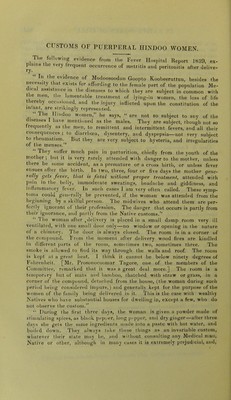
![CUSTOMS OF PUERPERAL HINDOO WOMEN. riie following evidence from the Fever Hospital Report 1839, ex- fhaiiis the very frequent occurrence of metritis and peritonitis after deli ve- in the evidence of Modoosoodun Goopto Koobeeruttun, besides the necessity that exists for affording to the female part of the population Me- ica assistance in the diseases to whirdi they are subject in common with t le men, the lamentable treatment of lying-in women, the loss of life thereby occasioned, and the injury inflicted upon the constitution of the infant, are strikingly represented. ‘ Ihe Hindoo women,” he says, “ are not so subject to any of the diseases I have mentiuned as the males. They are subject, though not so iiequently as the men, to remittent and intermittent fevers, and all their consequences ; to diarrhoea, dysentery, and dyspepsia—not very subject to rheumatism. But they are very subject to hysteria, and irregularities of the menses.” “ They suffer much pain in parturition, chiefly from the youth of the mother 5 but it is very rarely attended with danger to the mother, unless there be some accident, as a premature or a cross birth, or unless fever ensues after the birth. In two, three, four or five days the mother gene- rally gets fever, that is fatal without groper treatment, attended with pain in the belly, immoderate sweatings, headache and giddiness, and inflammatory fever. In such cases I am very often called. These symp- toms could generally be prevented, if the woman was attended from the beginning by a skilful person. The niidwives who attend them are per- fectly ignorant of their {)rofession. The danger that occurs is partly from their ignorance, and partly from the Native customs.” “ The woman after .delivery is placed in a small damp room very ill ventilated, with one small door only—no window or opening in the nature of a chimnej’. Tlie door is always closed. The room is in a corner of the compound. From the moment after delivery wood fires are kindled in different parts of the room, sometimes two, sometimes three. The smoke is allowed to find its way tlirough the walls and roof. The room is kept at a great heat. I think it cannot be below ninety degrees of Fahrenheit. [Mr. Prosonocoomar Tagore, one of the members of the Committee, remarked that it was a great deal more.] The room is a teinporiiry hut of mats and bamboo, thatched with straw or grass, in a Corner of the compound, detached from the house, (the woman during such period being considered impure,) and generally kept for the purpose of the women of the family being delivered in it. This is the case with wealthy Natives who have substantial houses for dwelling in, except a few, who do not observe tbe custom.” “ During the first three days, the woman is given a powder made of stimulating spices, as black pepper, long pe))per, and dry ginger—after three days she gets the same ingredients made into a paste with hot water, and boiFd down. They always take these things as an invariable custom, whatever their state may be, and without consulting any Medical man. Native or other, although in many cases it is extremely prejudicial, and,](https://iiif.wellcomecollection.org/image/b21959389_0664.jp2/full/800%2C/0/default.jpg)