The people's common sense medical adviser in plain English, or, Medicine simplified / by R.V. Pierce.
- Ray V. Pierce
- Date:
- 1890
Licence: Public Domain Mark
Credit: The people's common sense medical adviser in plain English, or, Medicine simplified / by R.V. Pierce. Source: Wellcome Collection.
Provider: This material has been provided by the University of Massachusetts Medical School, Lamar Soutter Library, through the Medical Heritage Library. The original may be consulted at the Lamar Soutter Library at the University of Massachusetts Medical School.
28/1034 page 20
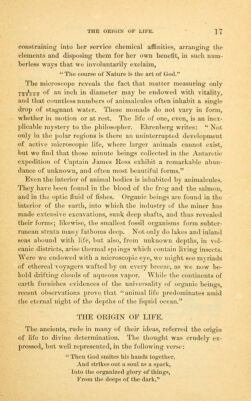
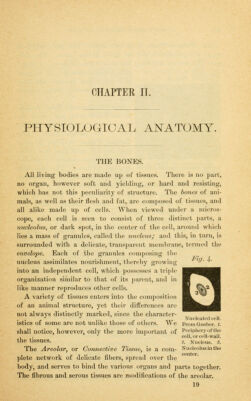
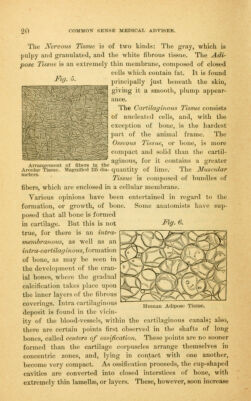
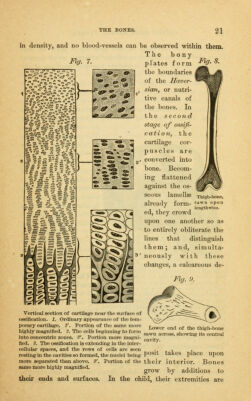
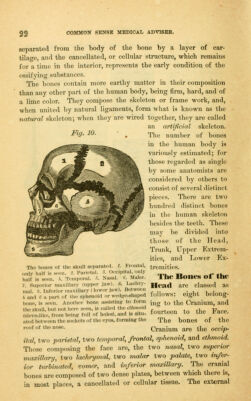
![Fig. 5. The Nervous Tissue is of two kinds: The gray, which is pulpy and granulated, and the white fibrous tissue. The Adi- pose Tissue is an extremely thin membrane, composed of closed cells which contain fat. It is found ]>rincipally just beneath the skin, ;-;iving it a smooth, plump appear- ance. The Cartilaginous Tissue consists ll^ of nucleated cells, and, with the ^ exception of bone, is the hardest ^ part of the animal frame. The Osseous Tissue, or bone, is more compact and solid than the cartil- aginous, for it contains a greater The Muscular Anuu^tment ot fibers in the . . Areolar Tissue. Mag-nifled ia5 dia- quantity 01 lime, meters Tissue is composed of bundles of fibers, which are enclosed in a cellular membrane. Various opinions have been entertained in regard to the formation, or growth, of bone. Some anatomists have sup- posed that all bone is formed in cartilage. But this is not -^V- ^• true, for there is an intra- membranous, as well as an introrcartilaginous, formation of bone, as may be seen in the development of the cran- ial bones, where the gradual calcification takes place upon the inner layers of the fibrous coverings. Intra cartilaginous deposit is found in the vicin- ity of the blood-vessels, within the cartilaginous canals; also, there are certain points first observed in tlie shafts of long bones, called centers of ossijicatiofi. These points are no sooner formed than the cartilage corpuscles arrange themselves in concentric zones, and, lying in contact with one another, become very compact. As ossification proceeds, the cup-shaped cavities are converted into closed interstices of bone, with extremely thin lamellae, or layers. These, however, soon increase Human Adipose Tissue.](https://iiif.wellcomecollection.org/image/b21197775_0028.jp2/full/800%2C/0/default.jpg)