A practical treatise on the diseases of the eye / by William Mackenzie ; to which is prefixed an anatomical introduction explanatory of a horizontal section of the human eyeball by Thomas Wharton Jones.
- Date:
- 1840
Licence: Public Domain Mark
Credit: A practical treatise on the diseases of the eye / by William Mackenzie ; to which is prefixed an anatomical introduction explanatory of a horizontal section of the human eyeball by Thomas Wharton Jones. Source: Wellcome Collection.
Provider: This material has been provided by the Royal College of Physicians of Edinburgh. The original may be consulted at the Royal College of Physicians of Edinburgh.
137/978
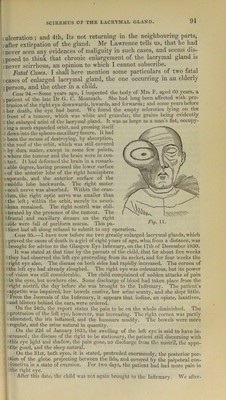
![ulceration; and 4th, Its not returning in the neighbouring parts, i after extirpation of the gland. Mr Lawrence tells us, that he had I never seen any evidences of malignity in such cases, and seems dis— jposed to think that chronic enlargement of the lacrymal gland is I never scirrhous, an opinion to which I cannot subscribe. Fatal Cases. I shall here mention some particulars of two fatal (cases of enlarged lacrymal gland, the one occurring in an elderly i person, and the other in a child. Case 94.—Some years ago, I inspected the body of Mrs F. aged 60 years, a I patient of the late Dr G. C. Monteath. Slie had long been affected with pro- ; trusionof the right eye downwards, inwards, and forwards; and some years before n her death, the eye had burst. We found the empty sclerotica lying on the ■ front of a tumour, which was white and granular, the grains being evidently the enlarged acini of the lacrymal gland. It was as large as a man’s list, occupy- ■ ] inga much expanded orbit, and pressing itself down into the spheno-maxillary fissure. It had been the means of destroying, by absorption, the roof of the orbit, which was still covered ■ by dura mater, except in some few points, . where the tumour and the brain were in con- - tact. It had deformed the brain in a reniark- ^ able degree, having pressed the lower surface 1,1 of the anterior lobe of the right hemisphere uupwards, and the anterior surface of the n middle lobe backwards. The right motor ooculi nerve was absorbed. Within the cran- iiium, the right optic nerve was smaller than ' the left; within the orbit, merely its neuri- 'nlema remained. The right nostril was obli- iterated by the presence of the tumour. The i'frontal and maxillary sinuses on the right > side were full of puriform mucus. This ])a- tient had all along refused to submit to any operation. Case 95.—I have now before me two greatly enlarged lacrymal glands, which , proved the cause of death in a girl of eight years of age, who, from a distance, was brought for advice to the Glasgow Eye Infirmary, on the 17th of December 1830. It was stated at that time by the parents of the child, that for about five weeks they had observed the left eye protruding from its socket, and for four weeks the right eye also. The disease on both sides had rapidly increased. Tho cornea of a the left eye had already sloughed. The right eye was axleinatous, but its power \ of vision was still considerable. The child complained of sudden attacks of pain I in the eyes, but nowhere else. Some discharge of blood had taken place from the ? right nostril, the day before she was brought to the Infirmary. The patient’s ; appetite was impaired, her bowels costive, her urine scanty, and she slept little. - From the Journals of the Infirmary, it appears that iodine, an opiate, laxatives, Jand blisters behind the cars, were ordered. On the 24th, the report states the pain to be on the whole diminished. The I protrusion of the left eye, however, was increasing. The right cornea was partly I ulcerated, the iris inflamed, and the humours muddy. The bowels were more S regular, and the urine natural in quantity. I On the 22d of January 1831, the swelling of the left eye is said to have in- I creased; the disease of the right to be stationary, the patient still discerning with * this eye light and shadow, the pain gone, no discharge from tho nostril, the aj)pc- ? tite good, and the sleep natural. ' On the 31st, both eyes, it is stated, protruded enormously, the posterior por- ;; tion of the globe projecting between the lids, and covered by the palpebral con- < junctiva in a state of eversion. For two days, the patient had had more pain in the right eye. After this date, the child was not again brought to the Infirmary. We after-](https://iiif.wellcomecollection.org/image/b28043467_0137.jp2/full/800%2C/0/default.jpg)