An introduction to the study of materia medica : being a short account of the more important crude drugs of vegetable and animal origin : designed for students of pharmacy and medicine / by Henry G. Greenish.
- Date:
- 1899
Licence: Public Domain Mark
Credit: An introduction to the study of materia medica : being a short account of the more important crude drugs of vegetable and animal origin : designed for students of pharmacy and medicine / by Henry G. Greenish. Source: Wellcome Collection.
Provider: This material has been provided by the Royal College of Physicians of Edinburgh. The original may be consulted at the Royal College of Physicians of Edinburgh.
155/560 (page 127)
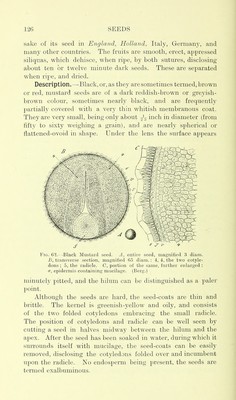
![Black mustard seeds, even when powdered, have no marked odom'. The taste is at first bitter, but rapidly becomes strongly pungent, and although the dry seeds are almost inodorous they develop, when moistened with water, a volatile substance of extreme ])ungency that rapidly attacks both the nostrils and the eyes. This volatile substance is not, however, developed if the seeds have been previously thrown into boiling water. The student should observe ; (a) The minute size and sj^herical shape, (b) The pitted surface, (c) The incumbent and folded cotyledons, as exhibited by seeds that have been cut transversely, or that have been soaked in water and divested of their seed- coats, ((?) The pungent taste ; and should compare these seeds with colchicum seeds, which are larger, rougher, harder than black mustard, and have a bitter, not pungent, taste. Constituents.—The kernel of black mustard seeds con- tains about 3;-^ per cent, of fixed oil, which can be obtained from the seed by crushing and pressing. In the seed-coat (in the cells of the epidermis) there is mucilage, which dissolves when the seeds are soaked in water. The seeds contain in addition two substances, sinigrin and myrosin, which, by inter- action in the presence of water, yield the volatile pungent bod}^ previously referred to ; the latter is not a constituent of the seed, but is produced only from two of its constituents under certain conditions. Sinigrin (also called potassium myronate) is a definite crystalline giucoside that can be extracted from black mustard seed by boiling with strong alcohol. Myrosin is an enzyme— that is to say, an unorganised ferment, capable, under suitable conditions of temperature &c., of inducing certain decomposi- tions in other substances. AVhen myrosin is added to an aqueous solution of sinigrin, allyl isosulphocyanide, potassium acid sulphate, and dextrose are forined. The following equa- tion represents the reaction that takes place : C,„H„,KNS,0„ + H,0 = C.,H,CSN + C,H,,0„ KHSO, This reaction does not, however, take place in the seed, since the myrosin and sinigrin are stored up in separate cells.](https://iiif.wellcomecollection.org/image/b21916111_0157.jp2/full/800%2C/0/default.jpg)