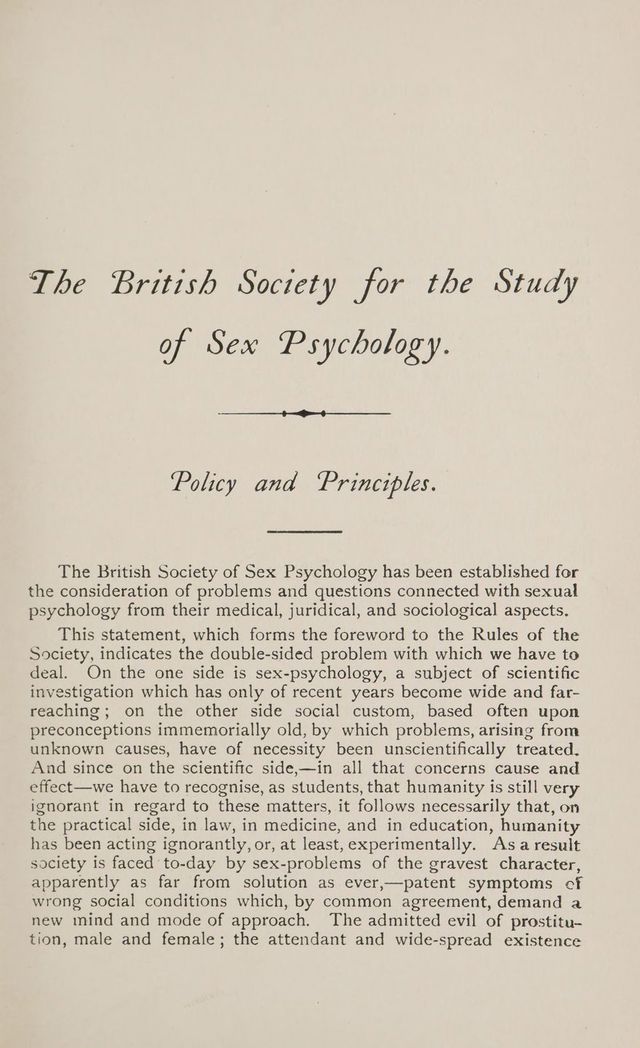
Policy & principles : general aims / British Society for the Study of Sex Psychology.
- British Society for the Study of Sex Psychology
- Date:
- [1914]
Licence: Public Domain Mark
Credit: Policy & principles : general aims / British Society for the Study of Sex Psychology. Source: Wellcome Collection.
4/16 page 4
![of blackmail which takes criminal advantage of the law as it now stands; the lack of proper safeguards for consent in sex-relations, free from all compulsion social, economic, or physical; the unsatis- factory conditions of marriage and divorce; the failure to deal equitably and soundly with the spread of venereal disease; the almost total absence of sex-training from education; al] these things are a cause of weakness and deterioration to the national life. And here, where science is most needed for right and effective treatment, science, so far as popular acceptance is concerned, is most lacking. We need, far more than we have it to-day, the co-operation of all classes of society,— experts willing to state and explain, laymen willing to learn. We need a general understanding that a huge unsolved problem of double aspect, intimate in its effect upon the lives of all, stands at our doors: on the one hand human nature waiting to be investigated; on the other failures in our social treatment of it needing to be exposed. The work of the Society will be to focus the conscience of the community on both sides of the problem. Many branches of the sex-problem will occupy the Society’s attention: the study of some of them has been hindered,—at times made even impossible—by the weight of moral judgment passed upon their outward manifestations ; while other manifesta- tions, because their significance in relation to the whole question of sex was not appreciated, have been treated as though socially unimportant, and no moral judgment whatever has been passed on them. In some cases, that is to say, ignorance and moral judgment have gone together to decide how certain problems should be treated; in other cases ignorance combined with social indifference has allowed them to be left to their own solution of natural decrease or increase. And when we consider instances of these two treatments side by side, it can hardly be said that an alliance ofiignorance and moral judgment has produced better results than a fortuitous leaving of the problem to take care of itself. It is not the business of our Society to say that moral judgments ought not to be formed, or that they may not have a very valuable place in the solution of our social problems, and the strengthening of those materials of life which are the real basis of a nation’s wealth ; but it is very much the business of the Society to insist that moral judgments founded on ignorance are more than likely to produce bad results, to insist also they must ever be open to nevision in the light of fuller knowledge.](https://iiif.wellcomecollection.org/image/b33424251_0004.jp2/full/800%2C/0/default.jpg)