Licence: Public Domain Mark
Credit: Sales catalogue 566: Maggs Bros. Source: Wellcome Collection.
80/302 page 60
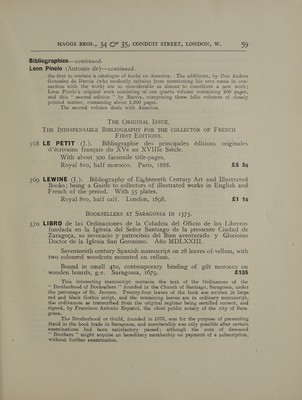
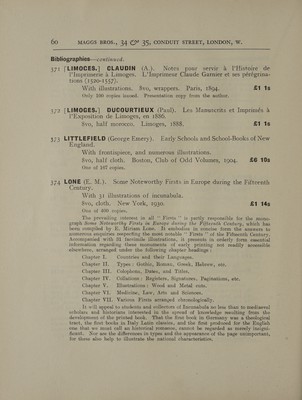
![Bibliographies—continucd. 371 [LIMOCES.] CLAUDIN (A.). Notes pour servir a J|’Histoire de l’ Imprimerie 4 Limoges. L’Imprimeur Claude Garnier et ses pérégrina- tions (1520-1557). ) With illustrations. 8vo, wrappers. Paris, 1894. £1 is Only 100 copies issued. Presentation copy from the author. — 372 [LIMOGES.| DUCOURTIEUX (Paul). Les Manuscrits et Imprimés a Exposition de Limoges, en 18860. 8vo, half morocco. Limoges, 1888. £1 1s 373 LITTLEFIELD (George Emery). Early Schools and School-Books of New England. With frontispiece, and numerous illustrations. 8vo, half cloth. Boston, Club of Odd Volumes, 1904. £6 10s One of 167 copies. 374 LONE (E. M.). Some Noteworthy Firsts in Europe during the Fifteenth Century. With 31 illustrations of incunabula. 8vo, cloth. New York, 1930. £1 14s One of 400 copies. a7 The prevailing interest in all ‘‘ Firsts ’’ is partly responsible for the mono- graph Some Noteworthy Firsts in Europe during the Fifteenth Century, which has been compiled by E. Miriam Lone. It embodies in concise form the answers to numerous enquiries respecting the most notable ‘‘ Firsts ’’ of the Fifteenth Century. Accompanied with 31 facsimile illustrations, it presents in orderly form essential information regarding these monuments of early printing not readily accessible elsewhere, arranged under the following chapter headings : Chapter I. Countries and their Languages. Chapter IJ. Types: Gothic, Roman, Greek, Hebrew, etc. Chapter III. Colophons, Dates, and Titles. Chapter IV. Collations: Registers, Signatures, Paginations, etc. Chapter V. Illustrations: Wood and Metal cuts. Chapter VI. Medicine, Law, Arts and Sciences. Chapter VII. Various Firsts arranged chronologically. It will appeal to students and collectors of Incunabula no less than to mediaeval scholars and historians interested in the spread of knowledge resulting from the development of the printed book. That the first book in Germany was a theological tract, the first books in Italy Latin classics, and the first produced for the English one that we must call an historical romance, cannot be regarded as merely insigni- ficant. Nor are the differences in types and the appearance of the page unimportant, for these also help to illustrate the national characteristics.](https://iiif.wellcomecollection.org/image/b31641155_0080.jp2/full/800%2C/0/default.jpg)


 No text description is available for this image
 No text description is available for this image
 No text description is available for this image