The physiology of digestion, considered with relation to the principles of dietetics / by Andrew Combe.
- Andrew Combe
- Date:
- 1860
Licence: Public Domain Mark
Credit: The physiology of digestion, considered with relation to the principles of dietetics / by Andrew Combe. Source: Wellcome Collection.
128/224 page 104
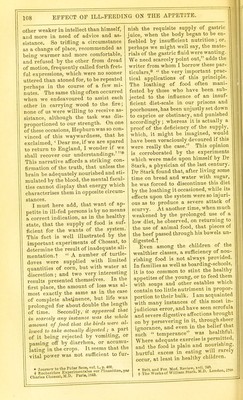
![cult to be had. In the Fifth Report of the Registrar-General to Parliament, of the births, marriages, and deaths in England and Wales, the connection of the mortality in Cheshire and Lanca- shire with the price of corn is exempli- fied by the following abstract:— 1QM /Ist six mo., 58/ 1 12d six mo., 70/ ] 1839, ,1840 - 1841, Price of Wheat. Deaths in 100,000. Males. Fem. 64/7 70/8 66/4 64/4 2697 2960 3069 2638 2439 2727 284G 2445 It is a rare thing for a hard-working artisan to arrive at a good old age; almost all become prematurely old, and die long before the natural term of life. Hence it is, that, as Dr South- wood Smith has remarked, the mor- tality of a country may be considered as an accurate indication of the misery of its inhabitants. According to Vil- lerme, the rate of mortality among the poor is sometimes double that among the rich. Thus, it is found, be says, that in a poor .district in France one hundred die, while in a rich depart- ment only fifty are carried ofi'; and that, taking into account the whole population of France, a child born to parents in easy circumstances has the chance of living forty-two and a half years, while one born of poor parents can look for no more than thirty.* These are striking facts, and their truth is amply confirmed by the Regis- trar-General's Reports. It appears, for instance, that while the deaths in a population of 273,000, occupying the seven Welsh districts, amounted in the third quarter of 1846 to 1465, they reached the fearfully greater num- ber of 3149 among the 263,000 inha- bitants of Manchester and Salford. (Ninth Annual Report, p. xxiii.) In the same Report, the Registrar says : The population of Surrey exceeded that of Manchester ; yet in seven years (1838-44), 16,000 persons died in Man- chester over and above the deaths in Surrey, the mortality in which, from the poverty of the labourer, and si igh ter * Smith's Phlloaophy of Health, chop. Iv. degrees of the influences so fatal in Manchester, is higher than it should ■ be. There were 23,523 children un- der 5 years of age in Surrey, and the deaths of children of that age were 7364; the children in Manchester were 21,152, the deaths 20,726. In the 7 years, 13,362 children in Manchester alone fell a sacrifice to known causes, which, it is believed, may be removed to a great extent; and the victims in Liverpool were not less numerous. (P. xxiv.) Many causes, no doubt, concur to produce these melancholy re- sults ; but among the principal must be placed the want of a diet sufficiently nutritious to repair the waste of the system, and, in the young, to supply the materials for growth. By the Re- gistrar of Deansgate, Manchester, the frightful mortality of the children is traced, in a great measure, to the un- fortunate out-door occupation of the women, which, by causing the with- holding of nature's nutriment from the children, is terribly destructive to the latter. In the army, the operation of the same principle has long been re- cognised, in the inferior strength and health of the privates compared with the officers. The officers, being better fed, clothed, and lodged than the com- mon soldiers, bear up successfully against fatigue and temporary priva- tions by which the latter are over- whelmed. During epidemics, too, the poor, from their impaired stamina, almost invariably become victims in a proportion far exceeding that of the more wealthy classes. This is, no doubt, partly owing to their greater intemperance and want of cleanliness; but even these vices often derive their origin from the same root—the want of adequate repose and sustenance. Nowhere, however, have the la- mentable consequences of an insuffi- ciency of wholesome food been exhi- bited on a larger and more destructive scale, and nowhere, perhaps, did the sufferings caused by it attract less of public attention and sympathy, than in the Royal Navy prior to the end of the last century. Every one has heard of the alarming mutiny of the fleet at Spithead, followed by that at the Nore,](https://iiif.wellcomecollection.org/image/b20404542_0128.jp2/full/800%2C/0/default.jpg)