Report of the sanitary committee of the commissioners of sewers of the city of London, together with a report of the medical officer of health on the objections raised by the Butchers' Trade Society to the bye-laws proposed for the regulation of slaughter-houses.
- City of London
- Date:
- 1876
Licence: Public Domain Mark
Credit: Report of the sanitary committee of the commissioners of sewers of the city of London, together with a report of the medical officer of health on the objections raised by the Butchers' Trade Society to the bye-laws proposed for the regulation of slaughter-houses. Source: Wellcome Collection.
Provider: This material has been provided by London School of Hygiene & Tropical Medicine Library & Archives Service. The original may be consulted at London School of Hygiene & Tropical Medicine Library & Archives Service.
38/60 page 36
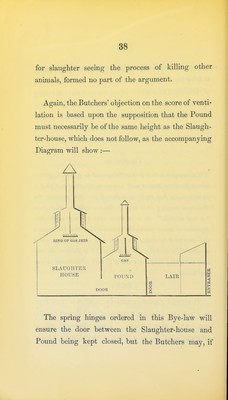
![liability of the walls becoming saturated with decay- ing nitrogenous matter by the constant absorption of moist animal vapours by porous bricks. [This pre- caution was suggested by a perusal of an account of the practical experiments of Professor Pettenkofer, of Munich, who has clearly demonstrated in various ways the extreme porosity of ordinary brick walls.] Lastly, a hard, smooth wall prevents the ingress and lodgment of vermin. The question of expense raised by the Butchers is hardly worthy of prosperous and wealthy tradesmen, and the objection that the cement would “ break off” is too frivolous to answer. Bye-law VII. That each Slaughter-house be provided with adequate lairagc or poundage, separated from the slaughtering space by a closed partition, extending from the floor to the roof, formed of brick, stone, slate, or other similar material, having a smooth impervious surface, to a height of at least 7 feet 6 inches from the floor. That in all cases where from the present plan of the premises a door is needed between the Lair or Pound and the slaughtering](https://iiif.wellcomecollection.org/image/b2476615x_0040.jp2/full/800%2C/0/default.jpg)