The analysis of potable water : with special reference to the determination of previous sewage contamination / by Charles Watson Folkard ; with an abstract of the discussion upon the paper, edited by James Forrest.
- Folkard, Charles Watson
- Date:
- 1882
Licence: Public Domain Mark
Credit: The analysis of potable water : with special reference to the determination of previous sewage contamination / by Charles Watson Folkard ; with an abstract of the discussion upon the paper, edited by James Forrest. Source: Wellcome Collection.
Provider: This material has been provided by The Royal College of Surgeons of England. The original may be consulted at The Royal College of Surgeons of England.
49/66 page 49
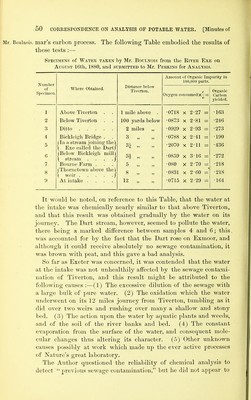
![that germs were no more amenable to the laws of dead organic Mr. Folkard. matter than a living man was. Again, every biologist was aware that the lower the organism the more persistent was its vitality, as a rule, and therefore a living germ was at the very least quite as capable of resisting oxidation during a 10 or 100, or 1,000 miles swim down a river (water being its appropriate medium) as was a hen's egg for an equal time or during transport through an equal distance in its appropriate medium, the atmosphere; and he thought few people would doubt the capacity of a hen's egg to germinate after such an interval and such treatment. Under the circumstances he could leave the members of the Institution to decide which of two chemists was the more likely to gain respect, the one who, after ten years' experience in water analysis, had come to the conclusion that the present methods were unreliable, and was willing to own it; or on the other hand, the one who tried to throw a halo of importance round a process admitted by nine-tenths of the analysts of the present day to be worthless, by stating that he had analysed nearly four thousand samples by it. It would be equally logical to say that hanging for sheep stealing was a good law because it had (unfortunately) been carried out hundreds of times in this country. In conclusion he must thank the members for the kind way in which they had listened to the Paper and to his remarks, and if it should be the means of directing still further attention to this important subject he should be extremely gratified. Correspondence. Mr. H. Percy Boulnois said that the Water Works of the City of Exeter, of which he had charge, were the property of the Corporation. The daily supply amounting to 1,280,000 gallons, was pumped from the river Exe, the intake being situated about 4 miles above Exeter and 12 miles below the town of Tiverton, the sewage of some ten thousand persons at this place being daily passed direct into the river in a crude state. To ascertain how far this sewage contamination chemically affected the water, he took samples from different points in the river in August 1880, and submitted them to Mr. F. P. Perkins, the public analyst of the City of Exeter, who examined them by the permanganate process and a modification of Professor Ditt- [thK INST. C.E. VOL. LXVIII.] E Mr. Boulnois.](https://iiif.wellcomecollection.org/image/b22278588_0051.jp2/full/800%2C/0/default.jpg)