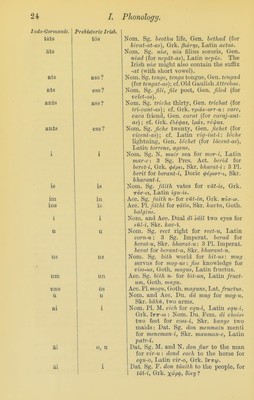
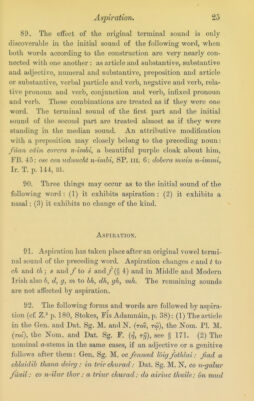
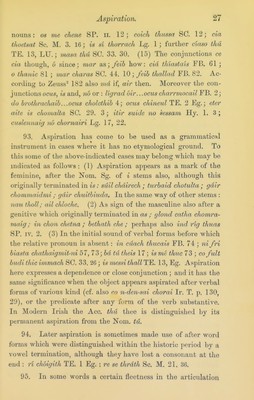
A concise Irish grammar : with pieces for reading / by Ernst Windisch ; translated from the German by Norman Moore.
- Ernst Windisch
- Date:
- 1882
Licence: Public Domain Mark
Credit: A concise Irish grammar : with pieces for reading / by Ernst Windisch ; translated from the German by Norman Moore. Source: Wellcome Collection.
Provider: This material has been provided by Royal College of Physicians, London. The original may be consulted at Royal College of Physicians, London.
48/208 (page 28)
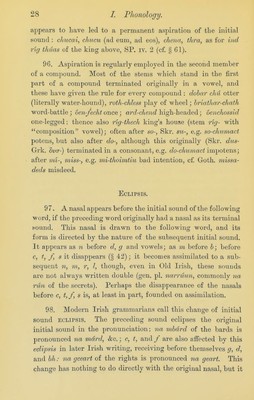
![appears to have led to a permanent asj^iration of the initial sound : chucai, chucu (ad eura, ad eos), chena, thra, as for ind rig thuas of the king above, SP. iv. 2 (cf. § 61). 9G. Aspiration is regularly employed in the second member of a compound. Most of the stems which stand in the first part of a compound terminated originally in a vowel, and these have given the rule for every com])ound : dohar cliu otter (literally water-hound), roth-chless play of wheel; hriathar-chath word-battle; oen-fecht once; ard-chend high-headed; oenchossid one-legged: thence also rig-thech king's house (stem rig- with composition vowel); often after so-, Skr. su-, e.g. so-chumact potens, but also after do-, although this originally (Skr. dus- Grk. hva--) terminated in a consonant, e.g. C(?o-c/m»?ac< impotens; after mi-, miss-, e.g. mi-thoimtiu bad intention, cf Goth, missa- deds misdeed. ECLIPSIS. 97. A nasal appears before the initial sound of the following word, if the preceding word originally had a nasal as its terminal sound. This nasal is drawn to the following word, and its form is directed by the nature of the subsequent initial sound. It appears as n before d, g and vowels; as m before b; before c, t, f, s it disappears (§ 42); it becomes assimilated to a sub- sequent n, m, r, I, though, even in Old Irish, these sounds are not always written double (gen. pi. narruun, commonly na run of the secrets). Perhaps the disappearance of the nasals before c, t, /, s is, at least in part, founded on assimilation. 98. Modern Irisli grammarians call this change of initial sound ECLIPSIS. The preceding sound eclipses the original initial sound in the pronunciation: na mhdrd of the bards is pronounced na mdrd, &c.; c, t, and / are also affected by this eclipsis in later Irish writing, receiving before themselves g, d, and bk: na gceart of the rights is pronounced na geart. This cliange has nothing to do directly with the original nasal, but it](https://iiif.wellcomecollection.org/image/b22652784_0048.jp2/full/800%2C/0/default.jpg)