Nugae canorae medicae : lays / by the Poet laureate of the New Town Dispensary.
- Date:
- 1873
Licence: Public Domain Mark
Credit: Nugae canorae medicae : lays / by the Poet laureate of the New Town Dispensary. Source: Wellcome Collection.
Provider: This material has been provided by the Royal College of Physicians of Edinburgh. The original may be consulted at the Royal College of Physicians of Edinburgh.
39/160 (page 21)
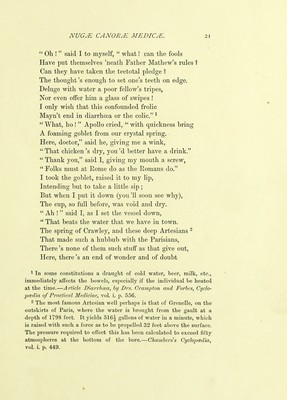
![Oh ! said I to myself, what! can the fools Have put themselves 'neath Father Mathew's rules % Can they have taken the teetotal pledge % The thought's enough to set one's teeth on edge. Deluge with water a poor fellow's tripes, Nor even offer him a glass of swipes ! I only wish that this confounded frolic Mayn't end in diarrhoea or the colic. ^ What, ho ! Apollo cried, with quickness bring A foaming goblet from our crystal spring. Here, doctor, said he, giving me a wink, That chicken's dry, you'd better have a drink. Thank you, said I, giving my mouth a screw, Folks must at Rome do as the Romans do. I took the goblet, raised it to my lip. Intending but to take a little sip; But when I put it down (you '11 soon see why). The cup, so full before, was void and dry. Ah ! said I, as I set the vessel down, That beats the water that we have in town. The spring of Crawley, and these deep Artesians ^ That made such a hubbub with the Parisians, There's none of them such stuff as that give out, Here, there's an end of wonder and of doubt ^ In some constitutions a draught of cold water, beer, milk, etc., immediately afifects the bowels, especially if the individual be heated at the time.—Article DiarrliCEa, by Drs. Crampton and Forbes, Cyclo- pcedia of Practical Medicine, vol. i. p. 556. 2 The most famous Artesian well perhaps is that of Grenelle, on the outskirts of Paris, where the water is brought from the gault at a depth of 1798 feet. It yields 516^ gallons of water in a minute, which is raised with such a force as to be propelled 32 feet above the surface. The pressure required to effect this has been calculated to exceed fifty atmospheres at the bottom of the bore.—Chambers's Cyclopaedia, vol. i. ]). 449.](https://iiif.wellcomecollection.org/image/b21945238_0039.jp2/full/800%2C/0/default.jpg)