A manual of dental anatomy : human and comparative / by Charles S. Tomes.
- Charles Sissmore Tomes
- Date:
- 1889
Licence: Public Domain Mark
Credit: A manual of dental anatomy : human and comparative / by Charles S. Tomes. Source: Wellcome Collection.
24/528 page 12
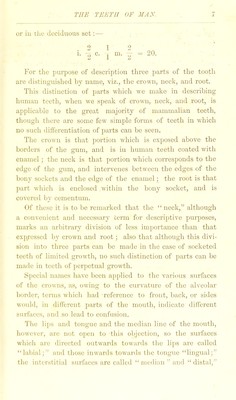
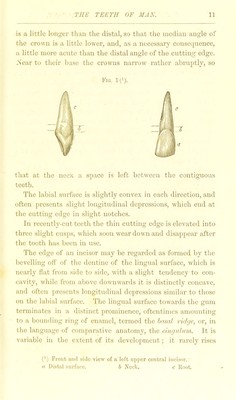
![into a central prominence at the back, but in the angle where the ridges of the two sides meet a deep pit is often left in the enamel, which is a favoindte site for caries. The crown, or what amounts to the same thing, the enamel, ter- minates on the lingual and labial aspect of the tooth in a curved line, the convexity of the curve being directed upwards towards the gum ; on the interstitial surfaces, both median and distal, the curve is less regular, and its contour wo\rld be more correct!}^ described as V-shaped, the apex of the V being towards the crown of the tooth and away from the gum. The dentist will do well to remember the disposition of the enamel in this situation, as it is a point of some importance in shaping the cervical edge of a cavity prcparntory to filling it. The transverse indentations of the enamel met with both on lingual and labial surfaces, though more especially in the latter, are marks of arrest of development, and, common as they are, are to be regarded as abnormalities. The central incisors are larger than the laterals, though not in so great degree as is the case in the anthropoid apes. The pulp cavity bears a general resemblance to the ex- ternal contour of tlie tooth ; towards the cutting edge it is very thin, and is prolonged at its two corners to a slight extent into “cornua;” at the neck it is cylindrical, and is also cylindrical in the root, tapering gradually till it ap- proaches close to tlie ajDex, when it becomes suddenly con- stricted. Upper lateral incisors are in every dimension some- what smaller' than the centrals. They widen somewhat abruptly near to the cutting edge, but below this they taper pretty regularly to the end of the root; the labial surface is convex in each direction, while the lingual surface is ])erhaps rather hatter than that of a central incisor. 'fhe outer (distal) angle of the crown is flir more rounded](https://iiif.wellcomecollection.org/image/b21499305_0024.jp2/full/800%2C/0/default.jpg)