A manual of dental anatomy : human and comparative / by Charles S. Tomes.
- Charles Sissmore Tomes
- Date:
- 1889
Licence: Public Domain Mark
Credit: A manual of dental anatomy : human and comparative / by Charles S. Tomes. Source: Wellcome Collection.
33/528 page 21
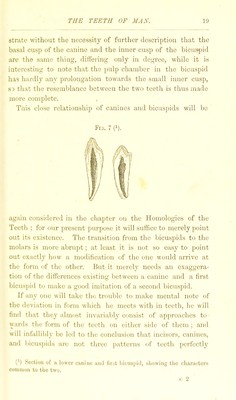
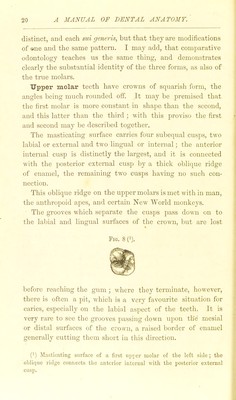
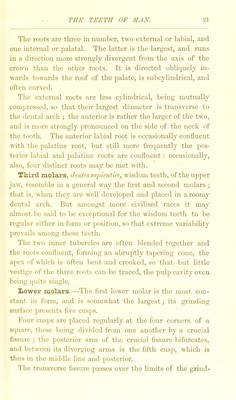
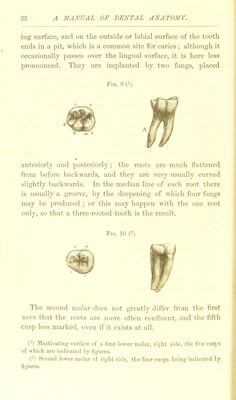
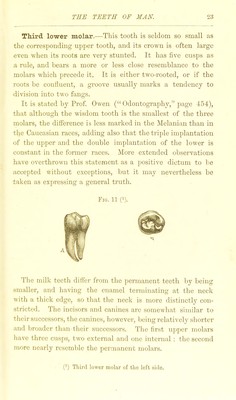
![The roots are three in number, two external or labial, and one internal or palatal. The latter is the largest, and runs in a direction more strongly divergent from the axis of the crown than the other roots. It is directed obliquely in- wards towards the roof of the palate, is snbcylindrical, and often curved. The external roots are less cylindrical, being mutually compressed, so that their largest diameter is transverse to the dental arch ; the anterior is rather the larger of the two, and is more strongly pronounced on the side of the neck of the tooth. The anterior labial root is occasionally confluent with the palatine root, but still more frequently the pos- terior labial and palatine roots are confluent : occasionally, also, four distinct roots may be met with. Thix’d molars, dentes scqnentice, wisdom teeth, of the upper jaw, resemble in a general way the first and second molars ; that is, when they are well developed and placed in a roomy dental arch. But amongst more civilised races it may almost be said to be exceptional for the wisdom teeth to be regular either in form or position, so that extreme variability prevails among these teeth. The two inner tubercles are often blended together and the I'oots confluent, forming an abruptly tapering cone, the apex of which is often bent and crooked, so that but little vestige of the three roots can be traced, the pulp cavity even being quite single. Lower molars.—The first lower molar is the most con- stant in form, and is somewhat the largest; its grinding surface presents five cusps. Four cusps are placed regularly at the four corners of a square, these being divided from one another by a crucial fissure ; the posterior arm of the crucial fissure bifurcates, and between its diverging arms is the fifth cusp, which is thus in the middle line and ])ostcrior. The transverse fissure [)asses over the limits of the grind-](https://iiif.wellcomecollection.org/image/b21499305_0033.jp2/full/800%2C/0/default.jpg)