A manual of dental anatomy : human and comparative / by Charles S. Tomes.
- Charles Sissmore Tomes
- Date:
- 1889
Licence: Public Domain Mark
Credit: A manual of dental anatomy : human and comparative / by Charles S. Tomes. Source: Wellcome Collection.
41/528 page 29
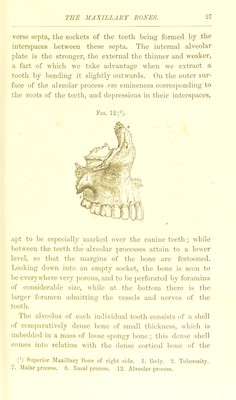
![The orbital and nasal surfaces concern us only through their relation to the antrum, to be presently described ; in the zygomatic surface, which is convex and forms part of the zygomatic fossa, are several orifices transmitting the posterior dental nerves and vessels ; a groove which, con- verted by the apposition of the palate bone into a canal, forms the posterior palatine canal; and at the bottom, a rounded eminence, the maxillaiy tuberosity, which lies behind the wisdom tooth, and has been occasionally broken off in extracting that tooth. The body of the bone is excavated by an air-chamber, the antrum, which is coated in life by a continuation of the nasal mucous membranej and this frequently becomes secondarily involved in dental disease, so that its anatomical relations are of great importance to the dentist. Like the somewhat similar air cavities in the frontal bone the maxillary sinus does not attain to its full size, relatively to the rest of the bone, until after the age of puberty, although it makes its appearance earlier than the other nasal sinuses, its presence being demonstrable about the fifth month of foetal life. Hence it follows that its walls are thicker in the young subject than in the adult; and, according to the observations of Mr. Cattlin ('), it is some- what larger in the male than in the female. It is very variable in size, so that out of one hundred adult specimens the above-mentioned writer found one which would only contain one drachm of fluid, while in con- trast with that was another which held eight drachms; two and a half drachms being the average capacity. Although it is exceedingly variable in form as well as in size, it tends towards a roughly pyramidal .shape, the a])cx of the pyramid being directed towards the malar bone, which it has been seen to encroach upon, and the base towards the nasal cavity; it is, however, useless to minutely describe (') “ Trans.'ictions of the Uilontologic.al Society,” vol. ii. IS.'n.](https://iiif.wellcomecollection.org/image/b21499305_0041.jp2/full/800%2C/0/default.jpg)