A manual of dental anatomy : human and comparative / by Charles S. Tomes.
- Charles Sissmore Tomes
- Date:
- 1889
Licence: Public Domain Mark
Credit: A manual of dental anatomy : human and comparative / by Charles S. Tomes. Source: Wellcome Collection.
43/528 page 31
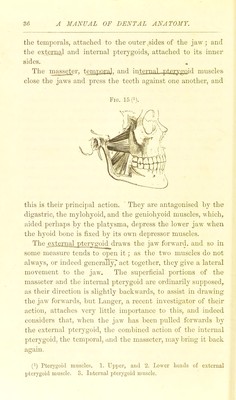
![ilutram is coutinuous with that of the nasal fossse, and, like that, it is ciliated ; but it ditl'ers from the latter in being thinner and less vascular. The teeth which usually come into the closest relation with the antrum are the first and second molars, but any of the teeth situated in the maxillary bone may encroach upon its walls, and I have seen an abscess, originating at the apex of the fang of a lateral incisor, pass backwards and ])crforate the antrum. Its walls have foiir aspects, namely, towards the orbit, the nose, the zygomatic fossa, and the face, while its floor is formed by the alveolar border. With the exception only of the latter, its walls are very thin ; and this exception has an important practical bearing in the diagnosis of tumors in this region, as accumulations of fluid or morbid growths really situated in the antrum bulge any or all of its walls in preference to the alveolar border, whereas tumors spring- ing from the base of the sphenoid or elsewhere and encroach- ing upon the antrum, push down and distort the alveolar border as edsily as any of the other walls of the cavit^, inasmuch as the pressure caused by them is not transmitted equally in all directions, as is the case when the medium transmitting the power is a fluid. The lower maxilla or mandible eonsists of a body and two rami, which ascend almost perpendicularly from its posterior extremity. The horizontal portion or bodv is curved sotnewhat in a parabolic form; it has a convex e.xtcrnal and concave intcnial surface, and an upper (alveolar) and a lower border. ()ii the convex facial surface we have to note the ridge marking the position of the symphysis, and below this the mental prominence, blxternallv to this, below the line of contact of the first and second bicuspids (or a little before or bcliiml this ])oint) is the mental fora- men, which constitutes the termination of the inferior dental canal. Running oblicpiely upwards, and first visible](https://iiif.wellcomecollection.org/image/b21499305_0043.jp2/full/800%2C/0/default.jpg)