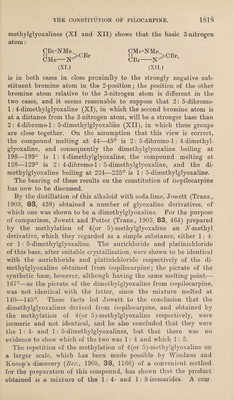
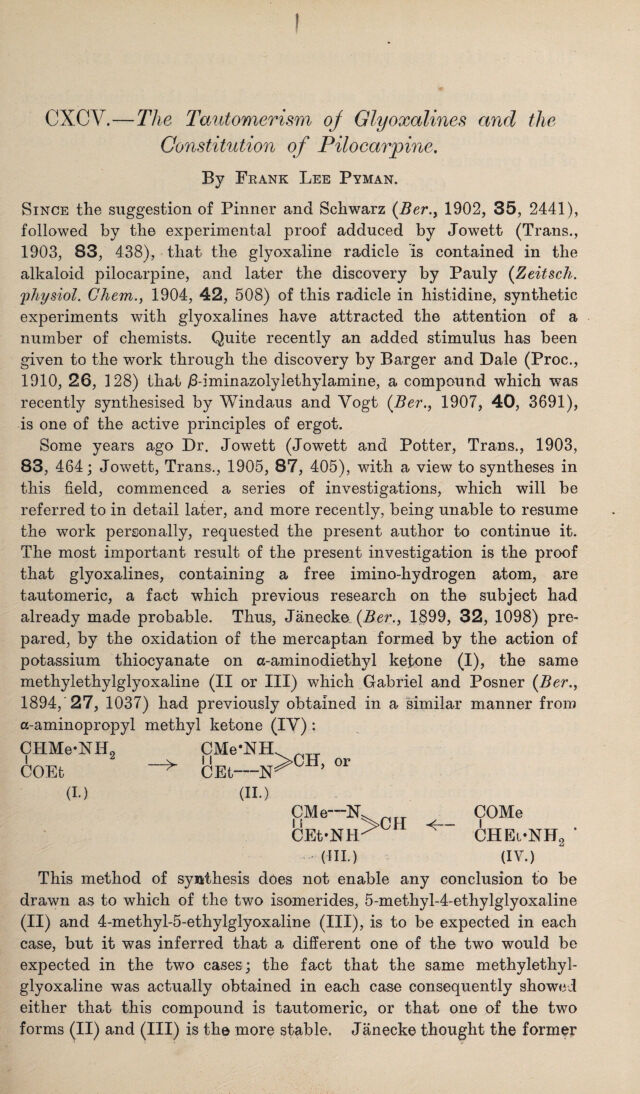
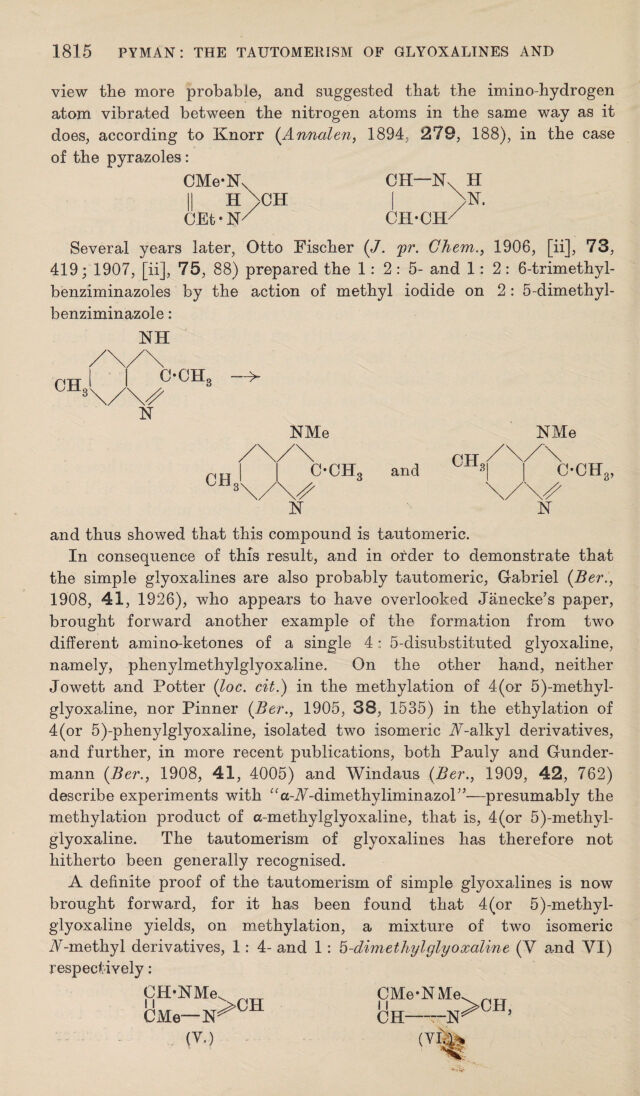
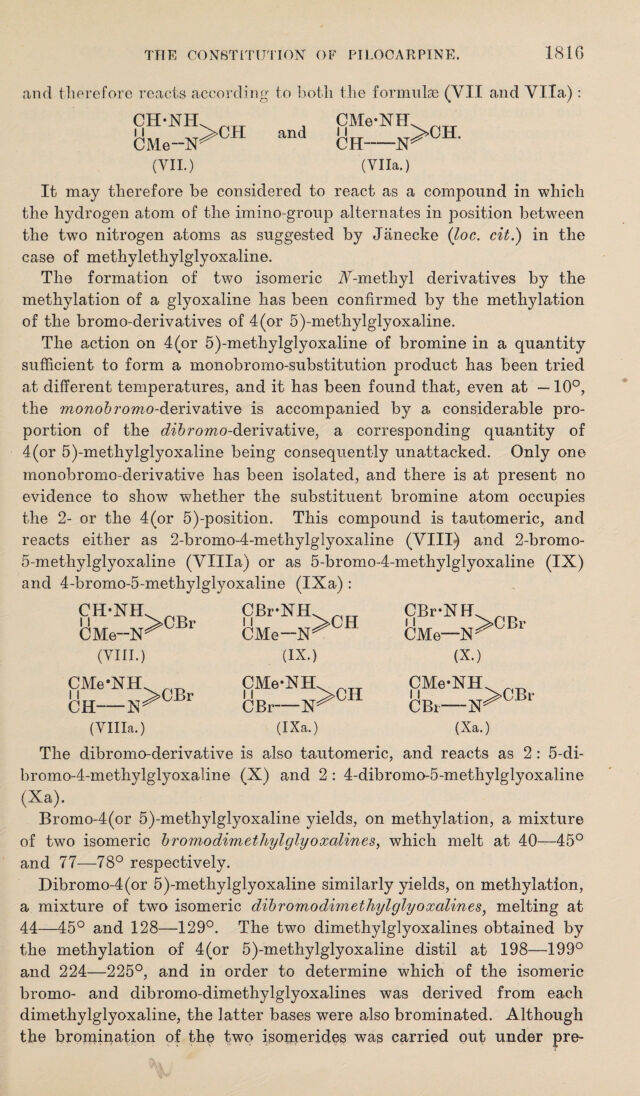
The tautomerism of glyoxalines and the constitution of pilocarpine / by Frank Lee Pyman.
- Pyman, Frank Lee.
- Date:
- [between 1910 and 1919?]
Licence: In copyright
Credit: The tautomerism of glyoxalines and the constitution of pilocarpine / by Frank Lee Pyman. Source: Wellcome Collection.
4/44 page 1817
![cisely similar conditions, the results showed an interesting difference, the dimethylglyoxaline boiling at 198-^-199° yielding chiefly the corresponding monobromo-derivative which melts at 40—45°, and very little of the dibromodimethylglyoxaline which melts at 44—45°; whilst the dimethylglyoxaline boiling at 224—225° gave very little of the corresponding monobromodimethylglyoxaline melting at 77—78°, but chiefly the dibromodimethylglyoxaline melting at 128—129° The mutual relations between the isomeric dimethylglyoxalines and the various bromo-derivatives are shown by the following scheme: 4(or 5)-Methylglyoxalme,—: 4-Dimethylglyoxaline, and 1:5-Dimethy]glyoxaline, C^HeN^. CgHgNa. C^HaN^. M. p. 55°; b. p. 263°. B. p. 198—199°. B. p. 224—225°. 1 ! Y 4^ y Bromo-4(or 5)-inethyl- 2(or 5)-Bromo-l: 4-dimethyl- 2(or 4)-Bromo-l: 5-dimethyl- glyoxaline, —glyoxalinc, and glyoxaliiie, C4H5N2Br. CgHyNgBr. C5H7N2Br. M. p. 154—155°. M. p. 40—45°. M. p. 77—78°. Dibromo-4(or 5)'methyl- 2:5-Dibromo-l: 4-dimethyl- 2:4-Dibromo-l: 5-dimethyl- glyoxaline, C4H4N2Br2. M. p. 215—216 glyoxaline, C^HfiNoBro. and glyoxaline, C5H6N2Br2. M. p. 44—45°. M. p. 128—129°. * The numbers are inserted in anticipation of the conclusions drawn later. The question as to which series has the 1: 4 and which the 1: 5 arrangement of methyl groups is difficult to determine, and no direct evidence bearing on this point is brought forward at present. Fortunately, however, this matter can be settled with a high degree of probability by consideration of the relative affinities of the two dibromodimethylglyoxalines. These compounds are weak bases, and it has been found that the isomeride melting at 128—129° is very much more readily extracted by means of chloroform from its solution in 10 per cent, hydrochloric acid than the isomeride melting at 44—45°; the latter is therefore the stronger base. Now, of the two nitrogen atoms in the glyoxaline molecule, the iminic nitrogen atom occupies a similar position to the nitrogen atom of pyrrole, and is almost devoid of basic properties. Glyoxalines behave as mono-acid bases, and the fact that their basicity is due to the nitrogen atom ‘NI has been clearly shown by Pinner and Schwarz {loc. cit.) by the formation of a mixture of mono- alkylamines by the degradation of alkyl salts of i\7-substituted glyoxalines. Consideration of the formulae of the two isomeric dibromodi-](https://iiif.wellcomecollection.org/image/b30622220_0004.jp2/full/800%2C/0/default.jpg)