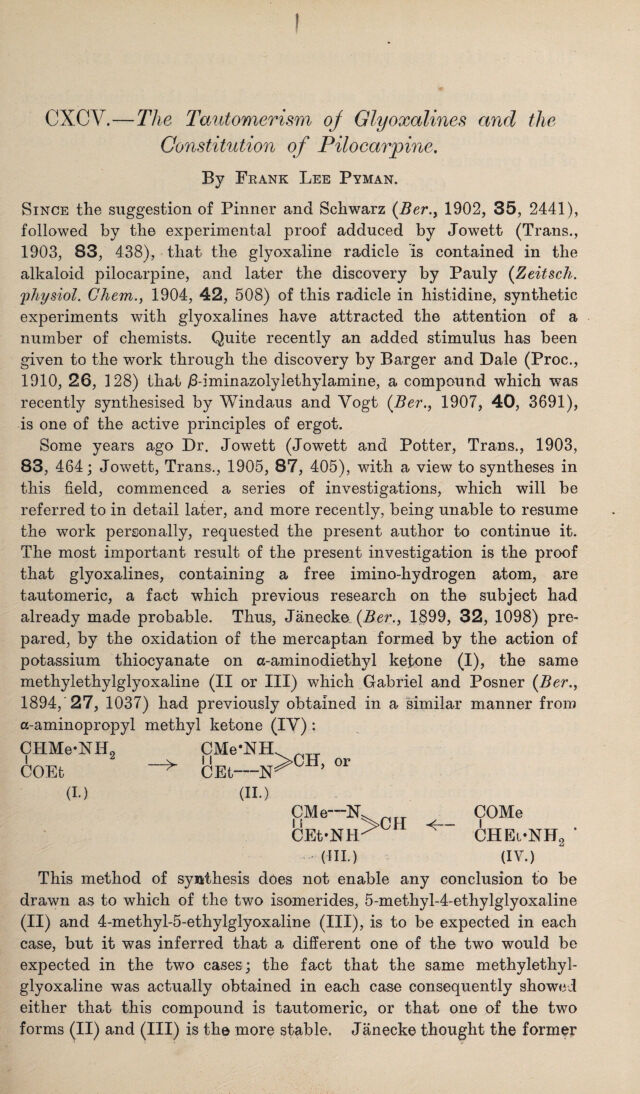
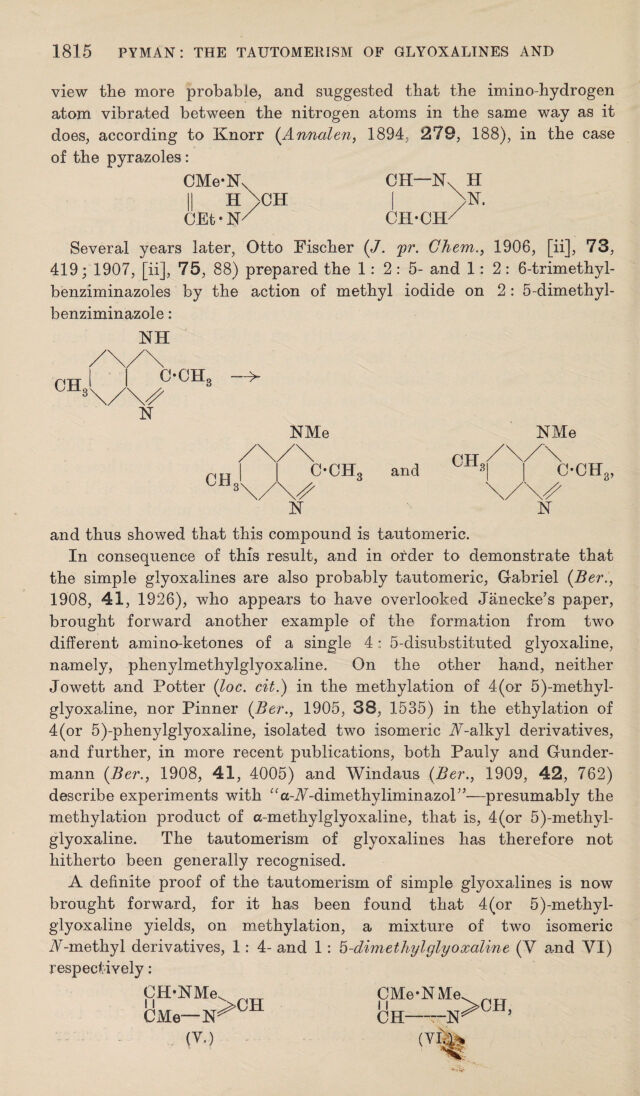
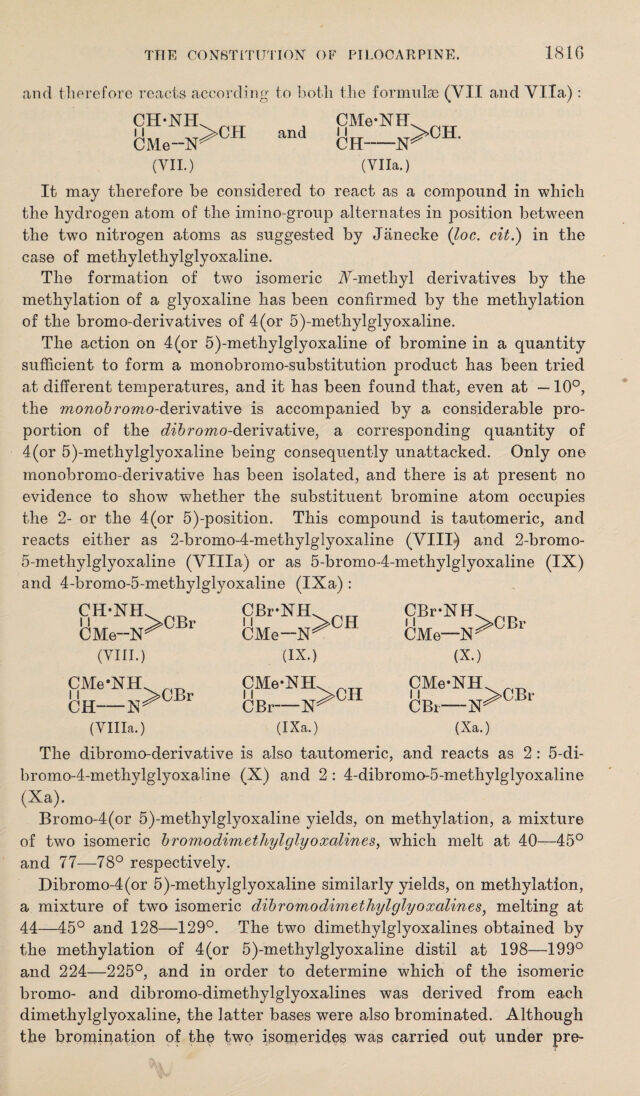
The tautomerism of glyoxalines and the constitution of pilocarpine / by Frank Lee Pyman.
- Pyman, Frank Lee.
- Date:
- [between 1910 and 1919?]
Licence: In copyright
Credit: The tautomerism of glyoxalines and the constitution of pilocarpine / by Frank Lee Pyman. Source: Wellcome Collection.
5/44 page 1818
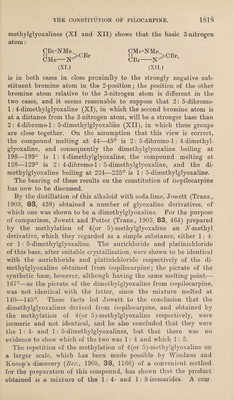
![metliylglyoxalines (XI and XII) shows that the basic 3-nitrogen atom: CBr-XMe CMe—N (XL) >CBr CMe-NMe^ CBr (XII.) is in both cases in close proximity to the strongly negative sub¬ stituent bromine atom in the 2-position; the position of the other bromine atom relative to the 3-nitrogen atom is different in the two cases, and it seems reasonable to suppose that 2: 5-dibromo- 1:4-dimethylglyoxaline (XI), in which the second bromine atom is at a distance from the 3-nitrogen atom, will be a stronger base than 2: 4-dibromo-l: 5-dimethylglyoxaline (XII), in which these groups are close together. On the assumption that this view is correct, the compound melting at 44—45° is 2 : 5-dibromo-l : 4-dimethyl¬ glyoxaline, and consequently the dimethylglyoxaline boiling at 198—199° is 1 : 4-dimethylglyoxaline, the compound melting at 128—129° is 2 : 4-dibromo-l: 5-dimethylglyoxaline, and the di¬ methylglyoxaline boiling at 224—225° is 1: 5-dimethylglyoxaline. The bearing of these results on the constitution of isopilocarpine has now to be discussed. By the distillation of this alkaloid with soda-lime, Jowett (Trans., 1903, 83, 438) obtained a number of glyoxaline derivatives, of which one was shown to be a dimethylglyoxaline. Bor the purpose of comparison, Jowett and Potter (Trans., 1903, 83, 464) prepared by the methylation of 4(or 5)-methylglyoxaline an i\^-methyl derivative, which they regarded as a simple substance, either 1: 4- or 1: 5-dimethylglyoxaline. The aurichloride and platinichloride of this base, after siiitable crystallisation, were shown to be identical with the aurichloride and platinichloride respectively of the di¬ methylglyoxaline obtained from isopilocarpine; the picrate of the synthetic base, however, although having the same melting point— 167°—as the picrate of the dimethylglyoxaline from isopilocarpine, was not identical with the latter, since the mixture melted at 140—145°. These facts led Jovv^ett to the conclusion that the dimethylglyoxalines derived from isopilocarpine, and obtained by the methylation of 4(or 5)-methylglyoxaline respectively, were isomeric and not identical, and he also concluded that they were the 1 : 4- and 1 : 5-dimethylglyoxalines, but that there was no evidence to show which of the two was 1 : 4 and which 1:5. The reiDetition of the methylation of 4(or 5)-methy]glyoxaline on a larger scale, which has been made possible by Wiiidaus and Knoop's discovery {Ber., 1905, 38, 1166) of a convenient method for the preparation of this compound, has shown that the product obtained is a mixture of the 1: 4- and 1: 5-isomerides. A com-](https://iiif.wellcomecollection.org/image/b30622220_0005.jp2/full/800%2C/0/default.jpg)