Milk composition in the United Kingdom / report of an Interdepartmental Committee.
- Great Britain. Interdepartmental Committee to Consider the Composition of Milk Sold off Farms in the United Kingdom.
- Date:
- [1960]
Licence: Public Domain Mark
Credit: Milk composition in the United Kingdom / report of an Interdepartmental Committee. Source: Wellcome Collection.
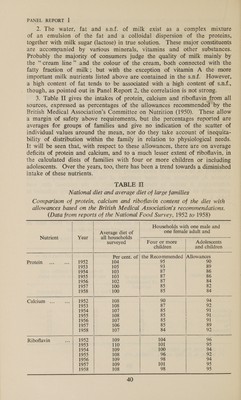
47/100 page 41
![4. These particular nutrients are associated with the s.n.f. fraction, and although milk is not the only source of them, except in the diets of very young children, it is, as indicated above, an important source. It is im fact the only really rich source of riboflavin. The consumption of bread, with its added calcium carbonate, is decreasing and milk and its products therefore ‘become relatively more important as sources of calcium. 5. The fact that certain nutrient intakes are on average below recom- mended intakes is not necessarily indicative of malnutrition. The recom- mended allowances represent the best estimates that could be made on evidence then available; but they may in certain respects be too high in relation to requirements. It should be stressed that there is mo sure evidence, and indeed little evidence of any sort, that malnutrition due to insufficiency of any of these nutrients does in fact exist in Britain. It should, however, be noted that where data on the growth of children have been analysed in terms of family size, children in larger families are on average not so tall or heavy as in smaller families. The cause is not clear, and there is no proof that any nutrient deficiency is involved, but it is noteworthy that in the past in this country, acceleration of growth has always been observed when milk has been fed as a supplement in controlled studies. 6. National Food Survey records indicate, though the data are not included here, that families of all types are on average consuming more than adequate amounts of vitamin A or its precursors. Desirable levels of the constituents of milk 7. The preceding paragraphs of this report indicate that a higher s.n-f. content is desirable in cows’ milk. But when the likely benefit of an increment is expressed quantitatively in the context of the national diet, it is seen to ‘be disappointingly small. We understand that it is highly unlikely that, even with the strongest incentives, operating over many years, there would be an average rise of s.n.f. of as much as 5 per cent. of the present levels. Applying the data in Table I and assuming that the amount of milk consumed did not alter, a 5 per cent. increase would only lead to an increase on average of about 1 per cent. in total protein intake, even in large families. The corresponding figures for calcium would be about 24 per cent. and for riboflavin a little less. 8. If a higher s.n.f. content were attained at the cost of a rise in the annual average retail price, the effect might be to nullify its benefit. Whilst there is evidence that milk consumption is on average much less susceptible than consumption of other foods to changes in price, we know of no evidence as to whether this is also true for large families in whom there is more likelihood of a shortage of the nutrients contributed by milk, nor do we know of evidence as to whether, particularly in these groups, a rise in price of milk might be offset by reduced expenditure upon some other beneficial foodstuff. 9, Nevertheless, the data shown in Table II and discussed in para- graph 3, coupled with what has been said in paragraph 5 about the growth of children, are in our view strong evidence in favour of an increase in consumption of s.nf. of milk, especially by children in large families. This does not necessarily mean that present levels of these nutrients in liquid milk must be increased, because much might be achieved by con- sumption of more milk or cheese or skim milk, or milk s.nf. in other articles of diet. The economic issues raised are outside our sphere. 4]](https://iiif.wellcomecollection.org/image/b32177483_0047.jp2/full/800%2C/0/default.jpg)