Rearing an imperial race : containing a full report of the second Guildhall school conference on diet, cookery and hygiene, with dietaries special reports from H. M. ambassadors abroad articles on children's food requirements, clothing, etc / edited by Charles E. Hecht.
- Date:
- 1913
Licence: In copyright
Credit: Rearing an imperial race : containing a full report of the second Guildhall school conference on diet, cookery and hygiene, with dietaries special reports from H. M. ambassadors abroad articles on children's food requirements, clothing, etc / edited by Charles E. Hecht. Source: Wellcome Collection.
132/592 page 76
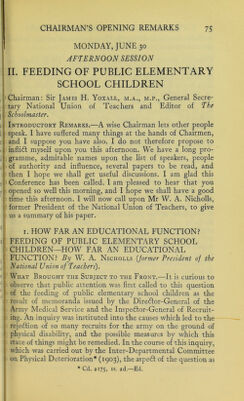
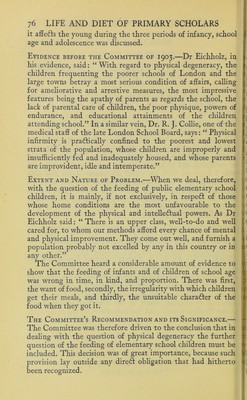
![it affefts the young during the three periods of infancy, school age and adolescence was discussed. Evidence before the Committee of 1903.—Dr Eichholz, in his evidence, said: “ With regard to physical degeneracy, the children frequenting the poorer schools of London and the large towns betray a most serious condition of affairs, calling for ameliorative and arrestive measures, the most impressive features being the apathy of parents as regards the school, the lack of parental care of children, the' poor physique, powers of endurance, and educational attainments of the children attending school.” In a similar vein, Dr. R. ]. Collie, one of the .! medical staff of the late London School Board, says: “ Physical I ■ infirmity is pradlically confined to the poorest and lowest strata of the population, whose children are improperly and insufficiently fed and inadequately housed, and whose parents are improvident, idle and intemperate.” Extent and Nature of Problem.—When we deal, therefore, with the question of the feeding of public elementary school children, it is mainly, if not exclusively, in respedf of those whose home conditions are the most unfavourable to the development of the physical and intelledfual powers. As Dr Eichholz said: ‘‘There is an upper class, well-to-do and well cared for, to whom our methods afford every chance of mental and physical improvement. They come out well, and furnish a population probably not excelled by any in this country or in any other.” The Committee heard a considerable amount of evidence to show that the feeding of infants and of children of school age was wrong in time, in kind, and proportion. There was first, the want of food, secondly, the irregularity with which children get their meals, and thirdly, the unsuitable charadfer of the food when they got it. The Committee’s Recommendation and its Significance.— The Committee was therefore driven to the conclusion that in dealing with the question of physical degeneracy the further question of the feeding of elementary school children must be included. This decision was of great importance, because such provision lay outside any diredf obligation that had hitherto { been recognized. \](https://iiif.wellcomecollection.org/image/b2807600x_0132.jp2/full/800%2C/0/default.jpg)
 No text description is available for this image
 No text description is available for this image
 No text description is available for this image