The natural history of common salt: its manufacture, appearance, uses, and dangers, in various parts of the world / [By C.T. i.e. C. Tomlinson].
- Charles Tomlinson
- Date:
- 1850
Licence: Public Domain Mark
Credit: The natural history of common salt: its manufacture, appearance, uses, and dangers, in various parts of the world / [By C.T. i.e. C. Tomlinson]. Source: Wellcome Collection.
103/376 page 91
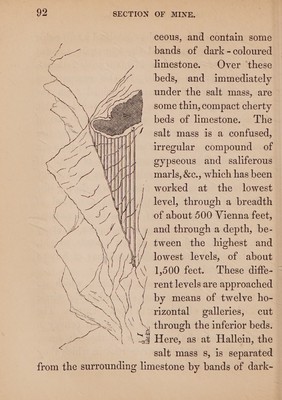
![ROCK-SALT AT ISCHL. 9] average each of these vaults contained 2,000 cubic fathoms of pure salt, and the aggregate amount of théir contents would be 200,000 cubic fathoms, or 2,500,000 tons of salt. In this computation is not included the quantity gained from the shafts, passages, stairs, &c., which would double the amount. The total would be 5,000,000 of tons, which is probably near the truth; for this would give for each year an average of between twelve and thirteen thousand tons of salt. If the price of a cwt. of salt has on an average been three florins, these mines have, during the 400 years of their existence, set a capital of three hundred millions of florins in circulation ; and, estimating the average consumption of every man, woman, and child, at ten pounds weight, have furnished three hundred millions of human beings with salt. The deposits of rock-salt at Ischl, which we are now about to notice, are situated in the circle of Salzburg, or of Salzach, in Upper Austria. The accompanying section of the works will convey a correct notion of the position of the salt mass, among the beds of limestone rock in which they are imbedded. The beds under the salt are argilla-](https://iiif.wellcomecollection.org/image/b33027341_0103.jp2/full/800%2C/0/default.jpg)
 No text description is available for this image
 No text description is available for this image
 No text description is available for this image