Licence: Public Domain Mark
Credit: Physiological chemistry (Volume 1). Source: Wellcome Collection.
Provider: This material has been provided by the National Library of Medicine (U.S.), through the Medical Heritage Library. The original may be consulted at the National Library of Medicine (U.S.)
46/686
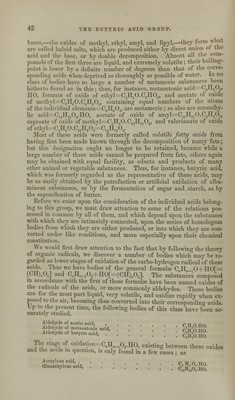
![.—the oxides of methyl, ethyl, amyl, and lipyl,—they form what arc called haloid salts, which are produced either by direct union of the acid and the base, or by double decomposition. Almost all the com- pounds of the first three are liquid, and extremely volatile ; their boiling- point is lower by a definite number of degrees than that of the corre- sponding acids when deprived as thoroughly as possible of water. In no class of bodies have so large a number of metameric substances been hitherto found as in this; thus, for instance, metacetonic acid=C6H503. HO, formate of oxide of ethyl=C4H5O.C2H03, and acetate of oxide of methyl=C2H3O.C4H303, containing equal numbers of the atoms of the individual elements=C6H604, are metameric; so also are oenanthy- lic acid=C14H]303.HO, acetate of oxide of amyl^C10HuO.C4H3O3, caproate of oxide of methyl=C2H3O.C12Hn03, and valerianate of oxide of cthyl=C4H5O.C10H9O3=C14HuO4. Most of these acids were formerly called volatile fatty acids from having first been made known through the decomposition of many fats; but this designation ought no longer to be retained, because while a large number of these acids cannot be prepared from fats, others again may be obtained with equal facility, as educts and products of many other animal or vegetable substances. Thus, for instance, butyric acid, which was formerly regarded as the representative of these acids, may be as easily obtained by the putrefaction or artificial oxidation of albu- minous substances, or by the fermentation of sugar and starch, as by the saponification of butter. Before we enter upon the consideration of the individual acids belong- ing to this group, we must draw attention to some of the relations pos- sessed in common by all of them, and which depend upon the substances with which they are intimately connected, upon the series of homologous bodies from which they are either produced, or into which they arc con- verted under like conditions, and more especially upon their chemical constitution. We would first draw attention to the fact that by following the theory of organic radicals, we discover a number of bodies which may be re- garded as lower stages of oxidation of the carbo-hydrogen radical of these acids. Thus we have bodies of the general formula; CH_ 0+HOf= (CH)n02] and C11Hn_102+HO[=(CH)n03]. The substances composed in accordance with the first of these formulae have been named oxides of the radicals of the acids, or more commonly aldehydes. These bodies are for the most part liquid, very volatile, and oxidize rapidly when ex- posed to the air, becoming thus converted into their corresponding acids. Up to the present time, the following bodies of this class have been ac- curately studied. Aldehyde of acetic acid, ... rnnnn Aldehyde of metacetonic acid, . ' rw n Sn Aldehyde of butyric acid, ......] Ch!o HO The stage of oxidation=CnHn_102.HO, existing between these oxides and the acids m question, is only found in a few cases ; as Acetylous acid, „ „ „ (Enanthylous acid, . . . . .' .' J .' c'h'&ho ylll3](https://iiif.wellcomecollection.org/image/b21136294_0046.jp2/full/800%2C/0/default.jpg)