Licence: Public Domain Mark
Credit: Physiological chemistry (Volume 1). Source: Wellcome Collection.
Provider: This material has been provided by the National Library of Medicine (U.S.), through the Medical Heritage Library. The original may be consulted at the National Library of Medicine (U.S.)
54/686
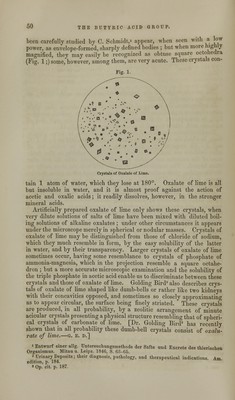
![been carefully studied by C. Schmidt,» appear, when seen with a low power, as envelope-formed, sharply defined bodies ; but when more highly magnified, they may easily be recognized as obtuse square octonedra (Fig. 1;) some, however, among them, are very acute. These crystals con- Fig, l. Crystals of Oxalate of Lime. tain 1 atom of water, which they lose at 180°. Oxalate of lime is all but insoluble in water, and it is almost proof against the action of acetic and oxalic acids; it readily dissolves, however, in the stronger mineral acids. Artificially prepared oxalate of lime only shows these crystals, when very dilute solutions of salts of lime have been mixed with diluted boil- ing solutions of alkaline oxalates ; under other circumstances it appears under the microscope merely in spherical or nodular masses. Crystals of oxalate of lime may be distinguished from those of chloride of sodium, which they much resemble in form, by the easy solubility of the latter in water, and by their transparency. Larger crystals of oxalate of lime sometimes occur, having some resemblance to crystals of phosphate of ammonia-magnesia, which in the projection resemble a square octahe- dron ; but a more accurate microscopic examination and the solubility of the triple phosphate in acetic acid enable us to discriminate between these crystals and those of oxalate of lime. Golding Bird2 also describes crys- tals of oxalate of lime shaped like dumb-bells or rather like two kidneys with their concavities opposed, and sometimes so closely approximating as to appear circular, the surface being finely striated. These crystals are produced, in all probability, by a zeolitic arrangement of minute acicular crystals presenting a physical structure resembling that of spheri- cal crystals of carbonate of lime. [Dr. Golding Bird3 has recently shown that in all probability these dumb-bell crystals consist of oxalu- rate of lime.—G. e. d.] » Entwurf einer allg. Untersuchungsmethode der Safte und Excrete des thierischen Organismus. Mitau u. Leipz. 1846, S. 63-65. 2 Urinary Deposits; their diagnosis, pathology, and therapeutical indications. Am. edition, p. 184. » Op. cit. p. 187.](https://iiif.wellcomecollection.org/image/b21136294_0054.jp2/full/800%2C/0/default.jpg)