Inaugural dissertation on temperament : submitted to the Medical Faculty of the University of Edinburgh / by Andrew Whyte.
- Andrew Whyte Barclay
- Date:
- 1840
Licence: Public Domain Mark
Credit: Inaugural dissertation on temperament : submitted to the Medical Faculty of the University of Edinburgh / by Andrew Whyte. Source: Wellcome Collection.
Provider: This material has been provided by The University of Glasgow Library. The original may be consulted at The University of Glasgow Library.
126/146 page 112
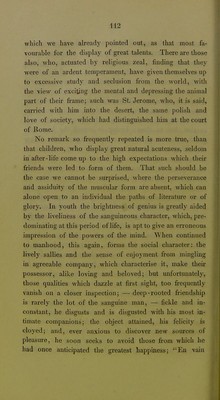
![which we have already pointed out, as that most fa- vourable for the display of great talents. There are those also, who, actuated by religious zeal, finding that they were of an ardent temperament, have given themselves up to excessive study and seclusion from the world, with the view of exciting the mental and depressing the animal part of their frame; such was St, Jerome, who, it is said, carried with him into the desert, the same polish and love of society, which had distinguished him at the court of Rome. No remark so frequently repeated is more true, than that children, who display great natural acuteness, seldom in after-life come up to the high expectations which their friends were led to form of them. That such should be the case we cannot be surprised, where the perseverance and assiduity of the muscular form are absent, which can alone open to an individual the paths of literature or of glory. In youth the brightness of genius is greatly aided by the liveliness of the sanguineous character, which, pre- dominating at this period of life, is apt to give an erroneous impression of the powers of the mind. When continued to manhood, this again, forms the social character: the lively sallies and the sense of enjoyment froni mingling in agreeable company, which characterise it, make then- possessor, alike loving and beloved; but unfortunatel}-, those qualities which dazzle at first sight, too frequently vanish on a closer inspection; — deep-rooted friendship is rarely the lot of the sanguine ]nan, — fickle and in- constant, he disgusts and is disgusted with his most in- timate companions; the object attained, his felicity is cloyed; and, ever anxious to discover new sources of pleasure, he soon seeks to avoid those from which he had once anticipated the greatest happiness; En vain](https://iiif.wellcomecollection.org/image/b2147008x_0126.jp2/full/800%2C/0/default.jpg)