Master Virgil : the author of the Æneid as he seemed in the middle ages a series of studies / by J.S. Tunison.
- Joseph S. Tunison
- Date:
- 1890
Licence: Public Domain Mark
Credit: Master Virgil : the author of the Æneid as he seemed in the middle ages a series of studies / by J.S. Tunison. Source: Wellcome Collection.
64/280 page 42
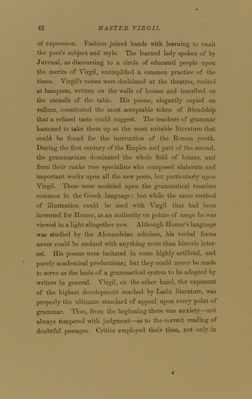
![of expression. Fashion joined hands with learning to exalt the poet’s subject and style. The learned lady spoken of by Juvenal, as discoursing to a circle of educated people upon the merits of Virgil, exemplified a common practice of the times. Virgil’s verses were declaimed at the theatres, recited at banquets, written on the walls of houses and in.scribed on the utensils of the table. His poem.s, elegantly copied on vellum, constituted the most acceptable token of friendship that a refined taste could suggest. The teachers of grammar hastened to take them up as the most suitable literature that could be found for the instruction of the Roman youth. During the first century of the Empire and ]>art of the second, the grammarians dominated the whole field of letters, and from their ranks rose specialists who compo.sed elaborate and important works uj)on all the new poets, but particularly upon Virgil. These Avere modeled upon the grammatical treatises common in the Greek language; but Avhile the same method of illustration could be used Avith Virgil that had been invented for Homer, as an authority on points of usage he was vicAved in a light altogether ucav. Although Homer’s language was studied by the Alexandrian scholars, his A'erbal forms never could be endued with anything more than historic inter- est. His poems Avere imitated in some highly artificial, and purely academical productions; but they could ncA'cr be made to serve as the basis of a grammatical system to be adopted by writers in general. Virgil, on the other hand, the! exponent of the highest doA-elopmcnt reached by Latin literature, Avas properly the ultimate standard of appeal upon CA-ery point of grammar. Thus, from the beginning there Avas anxiety—not ahvays tempered Avith judgment—as to the correct reading of doubtful passages. Critics employed their time, not only in 4](https://iiif.wellcomecollection.org/image/b24876719_0064.jp2/full/800%2C/0/default.jpg)




 No text description is available for this image
 No text description is available for this image
 No text description is available for this image