Intestinal toxaemias and their pathological significance : bulletin no. 1 / Dimol Laboratories, Limited.
- Date:
- [1924]
Licence: Public Domain Mark
Credit: Intestinal toxaemias and their pathological significance : bulletin no. 1 / Dimol Laboratories, Limited. Source: Wellcome Collection.
9/16 page 7
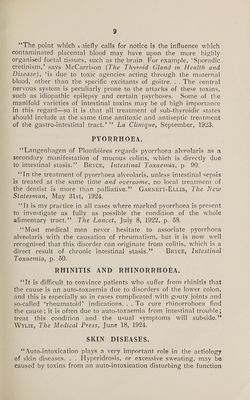
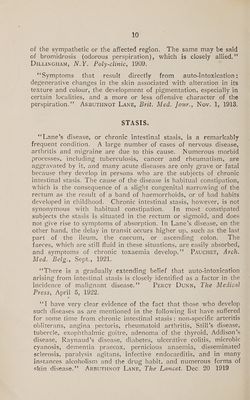
![digestive tract may sufficiently interfere with the absorption of the smal] amount of iodine available in the diet is a possibility, particularly in areas in which this element is relatively small. The relation of the bacterial flora to the available iodine would explain the geographical distribution of goitre.’? PLUMMER, Brit. Med. Jour., Feb. 4, 1922, p. 180. HEADACHE. ‘“‘Constipation is regarded by some observers as the point of origin of the majority of cases, the headache being symptomatic of a bowel toxaemia. It may well be that the circulating toxins are brought into close and prolonged contact with nerve centres rendered hyperaemic by functional or pathological stress.’? WaLsH, The Medical Press, August 2, 1922. ‘*] have found that about 95 per cent. of all cases of temporal headaches are of intestinal origin.’? Mack, Illinois Med. Jour., Seut., L911. HYPOTHYROIDISM. ‘“‘TIypothyroidism is one of the most prominent manifestations of intestinal toxaemia. It may therefore be argued that if this form of toxaemia be controlled by intestinal disinfection the demand upon the functional activity of the gland would cease to be excessive and the incidence of hypothyroidism would be prevented.’’ The Medical Press, Dec. 6, 1922. ““There seems to be some close connection between endocrine insufficiency and poisoning from intestinal absorption, and the results of using intestinal disinfectants in addition to aperients are rather striking.’’ SapLer, The Lancet, 1922, vol. I., p. 929. ‘fAs regards the mechanics involved, is it not reasonable to assume that one of the functions of the thyroid is to neutralise or destroy the toxic substances of intestinal putrefaction, and that, according as the volume of toxin increases or decreases, so will the thyroid continue to function ?”’ Paris Médical, Mar. 31, 1923. ‘“*As we have affirmed, the most important function of the thyroid is to supply the blood with its iodine content; also it is impossible to deny that the bactericidal action of the iodine is intended to keep under control the putrescent sources in the body. These are mostly of intestinal origin, and the greater their activity the greater becomes the demand upon the efficiency of the thyroid. But, in contending against this demand, the thyroid may fail in its action to check the pervading toxaemia. Hypothyroidism follows, and with it the many and varied effects associated with blood-contamination. Obviously, in all such cases, the first line of defence is intestinal disinfection.”’ La Clinique, September, 1923.](https://iiif.wellcomecollection.org/image/b33462550_0009.jp2/full/800%2C/0/default.jpg)
 No text description is available for this image
 No text description is available for this image
 No text description is available for this image