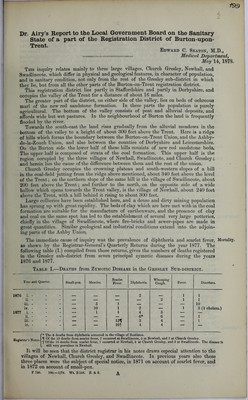
Dr. Airy's report to the local government board on the sanitary state of a part of the registration district of Burton-upon-Trent.
- Airy, Hubert, 1838-1903.
- Date:
- [1878]
Licence: Public Domain Mark
Credit: Dr. Airy's report to the local government board on the sanitary state of a part of the registration district of Burton-upon-Trent. Source: Wellcome Collection.
Provider: This material has been provided by London School of Hygiene & Tropical Medicine Library & Archives Service. The original may be consulted at London School of Hygiene & Tropical Medicine Library & Archives Service.
4/9 (page 3)
![3 Looking through the death-register of the Gresley sub-district, from the middle of 1876, the first appearance of “diphtheria” in the register is met with in February 1877, when, on the 21st and 22nd, the deaths of two children named Satchwell, aged 6 and 4 years, were registered from that disease. From the description given to me by the mother there can be no doubt that they died of true diphtheria. Four other children in the same family were also attacked, but recovered. This family lived in Castle Gresley (a little village adjoining Church Gresley, but at a lower level,) in one of 28 houses, known as “ New Row,” recently built for the accommodation of miners working in a neighbouring colliery. These houses are of a good class, but the pump which supplies them with drinking-water is only a few yards from the nearest privies and pigsties. I did not hear of any other cases in the Row at that time. The private medical attendant who had been called in to these and others of the earliest cases was unable to give me any information concerning them, except that they were generally isolated cases. The then medical officer of health has since resigned. The next appearance of diphtheria in the death-register is “ Rosliston, May 21, Henry Lovely, 4 years “May 31, Samuel Lovely, 17 years:” “June 1, John Lovely, “ 10 years :” “ June 8, Sarah Ann Lovely, 13 years :” “ June 16, Charles Lovely, “ 10 months :” “ June 29, Emma Lovely, 3 years.” These were six out of nine children of the same family. Rosliston, which had in 1871 a population of only 447, is a fairly wholesome little agricultural village, on a soil of new red sandstone marl about 100' feet above the level of the Trent, neither deeply buried nor bleakly exposed. The house in which these six deaths took place was the middle house of three which were built about three years ago. Two tenants had occupied the house previously without injury to health. The two adjoining houses have also been occupied, and are still occupied, without any similar outbreak of disease. The children from these two end houses (seven in number, at ages from 6 months to 13 years), though in frequent association with the sick children in the middle house, appear to have entirely escaped any attack, unless possibly one child was slightly affected. Water for washing pur- poses was for all three houses obtained from a pump at the back, 15 yards distant from the privy. The well was known to be polluted from a defective slop drain, and the water stank. [The drain has since been taken up and relaid and the water is much better, but is still not used for drinking.] Drinking water was obtained from a good well belonging to a public-house in the village. There is, however, no need to look to the condition of this house in Rosliston for the origin of the outbreak. The Lovelys had only come into the house three weeks before the boy Henry was attacked, bringing with them an elder boy, William, aged 16, who was just recovering from an attack of diphtheria. The family had previously been living at a neighbouring village, Cauld- well, and the boy William had been at work in a neighbouring coal-pit. There were no other cases of diphtheria in Cauldwell: there was nothing about the house they occupied there to cause disease, except that some refuse-heaps were rather too near to the back door: drinking water was got from the village pump : the situation of the village was quite wholesome. I think it may reasonably be supposed that William Lovely contracted diphtheria while at his work in the colliery, or perhaps in visiting Castle Gresley, where the disease had already taken hold. About the same time as the last diphtheria death in Rosliston, there was a death (at the age of 5 years) in Church Gresley, in a family which has subsequently left the district, about which I could get no information. At the end of June and beginning of July there were two fatal cases (at the ages of 6 and 1), in Castle Gresley, in a family named Swann. The elder of these two children had previously been playing with two of another family who were recovering from an ulcerative affection of the tongue and fauces, probably diphtheritic. Three others of the same family, aged 8, 4, and 2, recovered. About the same time three children in another family in the same village were attacked with a throat affection marked by the presence of patches “ like wash leather ” on the fauces, evidently diphtheria. All three recovered. More than three months later, with no intermediate history traceable, another fatal case, (age 10 years,) occurred in the New Row in Castle Gresley, where the Satchwells, the first cases mentioned above, had resided. Since then there have been no more diphtheria deaths in Castle Gresley ; but groups of cases have occurred in Church Gresley. On November 14, a child, aged 11, died of diphtheria in that part of Church Gresley township, known as Coppice Side, which belongs to the Swadlincote Urban District. The house is old and confined, and a slaughter-house stands close behind it. Privies stood close by, which have since been removed. Water, believed to be good, was obtained from a well at some distance. A 2](https://iiif.wellcomecollection.org/image/b24996051_0005.jp2/full/800%2C/0/default.jpg)