Agricultural drainage : a retrospective of forty years experience / J. Bailey Denton.
- John Bailey Denton
- Date:
- 1883
Licence: Public Domain Mark
Credit: Agricultural drainage : a retrospective of forty years experience / J. Bailey Denton. Source: Wellcome Collection.
17/112 page 5
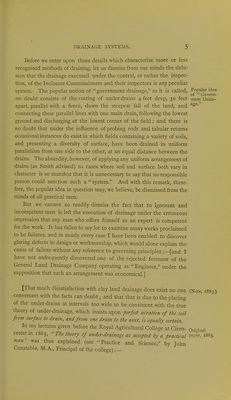
![Before we enter upon those details which characterise more or less recognised methods of draining, let us dismiss from our minds the delu- sion that the drainage executed under the control, or rather the inspec- tion, of the Inclosure Commissioners and their inspectors is any peculiar system. The popular notion of government drainage, as it is called, ■^f'P^^f of Govern- no doubt consists of the cuttmg of under-drams 4 feet deep, 30 feet ment Drain- J) apart, parallel with a fence, down the steepest fall of the land, and ^ connecting these parallel lines with one main drain, following the lowest ground and discharging at the lowest corner of the field ; and there is no doubt that under the influence of probing rods and tabular returns occasional instances do exist in which fields containing a variety of soils, and presenting a diversity of surface, have been drained in uniform paralleHsm from one side to the other, at an equal distance between the drains. The absurdity, however, of applying any uniform arrangement of drains (as Smith advised) to cases where soil and surface both vary in character is so manifest that it is unnecessary to say that no responsible person could sanction such a system. And with this remark, there- fore, the popular idea in question may, we believe, be dismissed from the minds of all practical men. But we cannot so readily dismiss the fact that to ignorant and incompetent men is left the execution of drainage under the erroneous impression that any man who offers himself as an expert is competent for the work. It has fallen to my lot to examine many works proclaimed to be failures, and in nearly every case I have been enabled to discover glaring defects in design or workmanship, which would alone explain the cause of failure without any reference to governing principles[and I have not unfrequently discovered one of the rejected foremen of the General Land Drainage Company operating as Engineer, under the supposition that such an arrangement was economical] [That much dissatisfaction with clay land drainage does exist no one (Note, 1883.) conversant with the facts can doubt; and that that is due to the placing of the under-drains at intervals too wide to be consistent with the true theory of under-drainage, which insists upon perfect aeration of the soil from surface to drain, and from one drain to the next, is equally certain. In my lectures given before the Royal Agricultural College at Ciren- Original cester m 1865, r/« theory of under-drainage as accepted by a practical W^^, 1865. man was thus explained (see Practice and Science, by John Constable, M.A., Principal of the college):—](https://iiif.wellcomecollection.org/image/b21782568_0017.jp2/full/800%2C/0/default.jpg)