Agricultural drainage : a retrospective of forty years experience / J. Bailey Denton.
- John Bailey Denton
- Date:
- 1883
Licence: Public Domain Mark
Credit: Agricultural drainage : a retrospective of forty years experience / J. Bailey Denton. Source: Wellcome Collection.
18/112 page 6
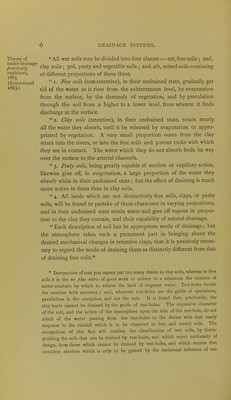
![Theory of All wet soils may be divided into four classes :—ist, free soils; 2nd, p-aciiai/fy^^^^ clay soils ] 3rd, peaty and vegetable soils ; and 4th, mixed soils consisting explained, 1865. (Reproduced 1883.) of different proportions of these three. I. J^ree soils (non-retentive), in their undrained state, gradually get rid of the water as it rises from the subterranean level, by evaporation from the surface, by the demands of vegetation, and by percolation through the soil from a higher to a lower level, from whence it finds discharge at the surface. *' 2. Clay soils (retentive), in their undrained state, retain nearly all the water they absorb, until it be released by evaporation or appro- priated by vegetation. A very small proportion oozes from the clay strata into the rivers, or into the free soils and porous rocks with which they are in contact. The water which they do not absorb finds its way over the surface to the arterial channels. 3. Featy soils, being greatly capable of suction or capillary action, likewise give off, in evaporation, a large proportion of the water they absorb while in their undrained state; but the effect of draining is much more active in them than in clay soils. 4. All lands which are not distinctively free soils, clays, or peaty soils, will be found to partake of these characters in varying proportions, and in their undrained state retain water and give off vapour in propor- tion to the clay they contain, and their capability of natural drainage. Each description of soil has its appropriate mode of drainage; but the atmosphere takes such a prominent part in bringing about the desired mechanical changes in retentive clays, that it is positively neces- sary to regard the mode of draining them as distinctly different from that of draining free soils.* * Irrespective of cost you cannot put too many drains in clay soils, whereas in free soils it is the ne plus ultra of good work to reduce to a minimum the number of under-conduits by which to relieve the land of stagnant water. Test-holes decide the number with accuracy ; and, wherever test-holes are the guide of operations, parallelism is the exception, and not the rule. It is found that, practically, the clay lands cannot be drained by the guide of test-holes. The expansive character of the soil, and the action of the atmosphere upon the side of the test-hole, do not admit of the water passing from the test-holes to the drains with that ready response to the rainfall which is to be observed in free and mixed soils. The recognition of this fact will confirm the classification of wet soils, by distin- guishing the soils that can be drained by test-holes, and which reject uniformity of design, from those which cannot be drained by test-holes, and which require that complete aeration which is only to be gained by the reciprocal influence of one](https://iiif.wellcomecollection.org/image/b21782568_0018.jp2/full/800%2C/0/default.jpg)