Agricultural drainage : a retrospective of forty years experience / J. Bailey Denton.
- John Bailey Denton
- Date:
- 1883
Licence: Public Domain Mark
Credit: Agricultural drainage : a retrospective of forty years experience / J. Bailey Denton. Source: Wellcome Collection.
59/112 page 47
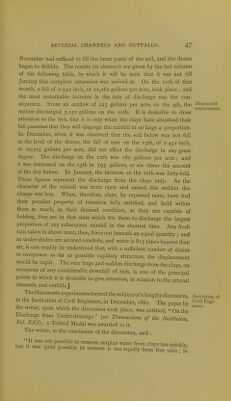
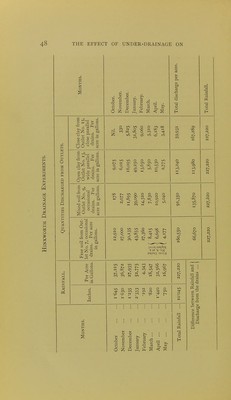
![November had sufficed to fill the inner pores of the soil, and the drains began to dribble. The results (in abstract) are given by the last column of the following table, by which it will be seen that it was not till January that complete saturation was arrived at. On the loth of that month, a fall of 0*542 inch, or 12,262 gallons per acre, took place; and the most remarkable increase in the rate of discharge was the con- sequence. From an outflow of 125 gallons per acre, on the 9th, the Hinxworth , ,. , experiments, outlets discharged 5,150 gallons on the loth. It is desirable to draw attention to the fact, that it is only when the clays have absorbed their full qtianium that they will disgorge the rainfall in so large a proportion. In December, when it was observed that the soil below was not full to the level of the drains, the fall of rain on the 13 th, of 0-452 inch, or 10,225 gallons per acre, did not affect the discharge in any great degree. The discharge on the 12th was 160 gallons per acre; and it was increased on the 13th to 795 gallons, or six times the amount of the day before. In January, the increase on the loth was forty-fold. These figures represent the discharge from the clays only. As the character of the subsoil was more open and mixed, this sudden dis- charge was less. When, therefore, clays, by repeated rains, have had their peculiar property of retention fully satisfied, and hold within them as much, in their drained condition, as they are capable of holding, they are in that state which fits them to discharge the largest proportion of any subsequent rainfall in the shortest time. Any fresh rain taken in above must, then, force out beneath an equal quantity; and as under-drains are aerated conduits, and water is 817 times heavier than air, it can readily be understood that, with a sufficient number of drains to overpower as far as possible capillary attraction, the displacement would be rapid. The very large and sudden discharge from the clays, on occasions of any considerable downfall of rain, is one of the principal points to which it is desirable to give attention, in relation to the arterial channels and outfalls.] The Hinxworth experiments formed the subject of a lengthy discussion. Institution of at the Institution of Civil Engineers, in December, 1861. The paper by ^S' the writer, upon which the discussion took place, was entitled, Onthe Discharge from Under-drainage Transactions of the Institution, Vol. XXT); a Telford Medal was awarded to it. The writer, at the conclusion of the discussion, said : It was not possible to remove surplus water from clays tooquicklv but It was quite possible to remove it too rapidly from freTsoils rS](https://iiif.wellcomecollection.org/image/b21782568_0059.jp2/full/800%2C/0/default.jpg)