Licence: In copyright
Credit: Entomology for medical officers. Source: Wellcome Collection.
Provider: This material has been provided by London School of Hygiene & Tropical Medicine Library & Archives Service. The original may be consulted at London School of Hygiene & Tropical Medicine Library & Archives Service.
68/376 (page 44)
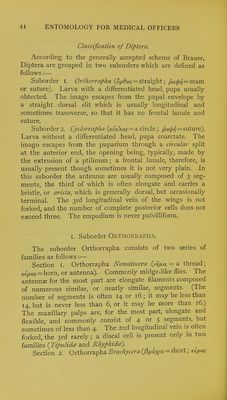
![Classification of Diptera. According to the generally accepted scheme of Brauer, Diptera are grouped in two suborders which are defined as follows:— Suborder I. Orthorrapha (6p6og = straight; pufoi = seam or suture). Larva with a differentiated head, pupa usually obtected. The imago escapes from the pupal envelope by a straight dorsal slit which is usually longitudinal and sometimes transverse, so that it has no frontal lunule and suture. Suborder 2. Cyclorrapha (kvk\os = a circle; pa<p/] = suture). Larva without a differentiated head, pupa coarctate. The imago escapes from the puparium through a circular split at the anterior end, the opening being, typically, made by the extrusion of a ptilinum; a frontal lunule, therefore, is usually present though sometimes it is not very plain. In this suborder the antennae are usually composed of 3 seg- ments, the third of which is often elongate and carries a bristle, or arista, which is generally dorsal, but occasionally terminal. The 3rd longitudinal vein of the wings is not forked, and the number of complete posterior cells does not exceed three. The empodium is never pulvilliform. 1. Suborder Orthorrapha. The suborder Orthorrapha consists of two series of families as follows :— Section I. Orthorrapha Nernatocera (i^/xa = a thread; Kepa<s = horn, or antenna). Commonly midge-like flies. The antennae for the most part are elongate filaments composed of numerous similar, or nearly similar, segments. (The number of segments is often 14 or 16 ; it may be less than 14, but is never less than 6, or it may be more than 16.) The maxillary palps are, for the most part, elongate and flexible, and commonly consist of 4 or 5 segments, but sometimes of less than 4. The 2nd longitudinal vein is often forked, the 3rd rarely ; a discal cell is present only in two families (Tipulidce and Rhyphidcs). Section 2. OrthorraphaBrachycadifipax^shorti KePa^](https://iiif.wellcomecollection.org/image/b2135666x_0070.jp2/full/800%2C/0/default.jpg)