Volume 3
Report of the departmental committee on sickness benefit claims under the National Insurance Act.
- Great Britain. Sickness Benefits Claims Committee.
- Date:
- 1914
Licence: Public Domain Mark
Credit: Report of the departmental committee on sickness benefit claims under the National Insurance Act. Source: Wellcome Collection.
50/512 (page 42)
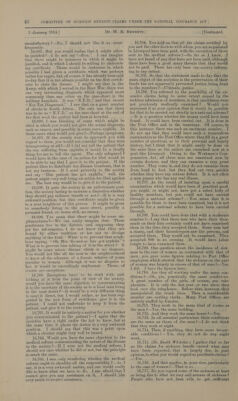
![1 January 1914.] [ Continued. because I hope thatit will not. I would rather say that it may have some effect in certain cases. 16,612. The system of payment on the capitation basis will have that tendency ?—I should say that any system by which you only attend one member of a family under any scheme will have that tendency. 16,613. You seemed to me to assent to a suggestion contained in a question put to you by Dr. Shaw that there was some sort of financial consideration in attending private patients. Dr. Shaw suggested to you that it was almost impossible to design any system whereby a doctor in attending his patients would not be influenced to some extent by financial considera- tions P—I did not understand that question. I consider that the average medical practitioner would give as good attendance, as far as medical examination and treatment goes, whatever the fee would be. I do not say that he would spend as long over it, but he would give as good actual attendance, whether the patient was poor or rich. 16,614. The point was not so much the quality of the treatment as the question of giving offence by ‘something he may do or say to the patients P—You mean that he would be more careful to speak to them plainly if he thought that he was getting paid highly, than if he was getting paid to a less extent. I should think that that would have a certain influence. If a man was getting a big fee, he would probably be more careful what he said to the person than if he was not. People paying a big fee are perhaps more sensitive than others who do not. You may tell a carter or a bricklayer that he is a ‘silly fool,” and he will think it is rather mild language. He will call his dearest friend or his wife something worse than that. But if you go to a gentleman who lives in a nice large house, with a large number of servants, and tell him he is a “silly fool,” he will probably send for the butler to put you out. 16,615. We may take it, generally speaking, that a private patient wants his doctor to get him well as quickly as possible P—Yes. 16,616. Therefore, the doctor, 1m order to please the patient, will try his hardest to get’ him well and back to his work at the earliest possible moment ?— To please his patient ? He will get him well as quickly as possible for a good many reasons before that enters in at all. I should want to get a patient well as quickly as possible for my sake, because I think that it is the proper thing to do. 16,617. Then the position of the panel patient is somewhat different. The existence of this Committee proves that there is a suspicion, at all events, that the panel patient does not want to get well. At all events, he does not want the doctor to tell him that he has got well quickly ?—He wants to be well, but to be regarded as unwell. That is what you mean ? 16,618. Yes P—Of course, I do not agree that there is very much of that in Liverpool. From what I have heard and seen and know, I think that there is a little of that, but it is a very sma)l amount. 16,619. Whether there is little or much, we all agree that there is some ?—We all agree that state- ments have been made that there is a great amount. 16,620. At all events, the doctor will best please & private patient by gettmg him well quickly, and telling him he is well ?—TI should say so, decidedly. 16,621. And if there is anything in this suspicion, that a proportion of panel patients want to draw sick- ness benefit, the doctor would best please the panel patient by telling him that he was incapable of work for some period longer than he was actually incapable ? —Certainly. 16,622. With regard to the private patient, the doctor will get his fee, and will be better appreciated if he gets the patient well quickly from the patient’s point of view ?—Theoretically, he should. In practice it does not always follow, I am sorry to say. 16,623. Supposing he displeases the panel patient, there is a probability that he will choose another doctor at the end of the year?—Yes. But in Liver- pool, out of a quarter of a ‘million of insured persons, only 600 have changed their doctor of their own will at the end of last year. 16,624. What is the point of view of the doctor with regard to his relationship to the approved society to which the patients belong ?—I do not think really that the doctor thinks much about the approved society. He does not know to what society the patient belongs. He knows that most of them must belong to a society, but I do not think that he ever considers his relation unless it is put to him. 16,625. Do you consider that you have at present any relationship of any sort or kind to the approved society to which your panel patients belong ?—I con- sider that there is a sort of vague relationship, but it is one which is never brought before my notice very strongly, and which I never think much about. 16,626. Do you think that you have any responsi- bility towards the society ?—I do undoubtedly think that I have a responsibility, but I feel that, provided I do my work conscientiously, my responsibility ends. It is included in conscientious work. I do not consider that I have any responsibility outside keeping my agreement and doing conscientious work, that is to ment as I am capable of giving, and giving him the required certificates, when I think they are necessary. 16,627. Supposing you have a private patient and a panel patient suffering from exactly the same com- plaint, and when they have recovered, you are convinced that it would do them good to have a long rest, say a month or six weeks. The private patient will have sufficient means to enable him to take that rest, but the panel patient could only take it by drawing on the funds of his society, when he was actually capable of work. What should you do in the case of the panel patient P—My endeavour, as I think the endeavour of the medical profession generally, is to treat the patients in exactly the same way. I should have, first of all, to make up my mind in the case you instance as to exactly what I meant by doing good to the patient after he recovered from his illness. TI suppose that it would do us all good if we had a month’s holiday, but I should not be prepared to give a certificate merely for the purpose of doing a patient good. I should have to consider whether that patient was now sufficiently well to follow his usual oceu- pation without injuring his health; and whéther he was in a normal state of health. If I thought that he was, I should say, ‘‘ You are well enough to go back to “ work; if you like to take a holiday, do so, but you “ have sufficiently recovered to go back.’ A holiday is a very nice thing to take, but I should certainly not give a certificate merely because I. thought that it- would do the patient good. If I thought that he had not reached a normal state of health, and that going back to work would injure his health, I should say thas it was necessary; but I should do my best to draw a line between what was necessary and advisable on the one hand, and what was agreeable and pleasant, but not necessary, on the other hand. 16,628. Do you find that the approved societies in every case accept your certificates and pay sickness benefit upon them ?—So far as I know, they have. I do not know of any case where they have not done so. 16,629. You never heard of a case of one of your certiticates being questioned P—Only in the case of inaccuracy in the man’s name, or something like that. 16,630. You are in touch with the other Liverpool doctors.. Can you tell us whether generally in Liverpool, the societies, without any sort of questions, consider the doctors’ certificates a sufficient proof of intapacity to pay sickness benefit upon ?—I feel convinced that they do. I do not think that there has been any trouble in that direction, except in those chronic cases where the referee comes in. =? 16,651. Do you consider that the societies go further than that, and consider that they are bound to pay upon production of the doctor’s certificate ?—L consider that they are. I have always understood so. 16,632. That is your view, that the doctor’s certi- ficate constitutes the whole evidence which need be produced in support of a claim for sickness benefit ?—I should say that it certainly constitutes the main evidence, but one can imagine that a sick visitor might bring information before the society that a person was](https://iiif.wellcomecollection.org/image/b32180445_0003_0050.jp2/full/800%2C/0/default.jpg)