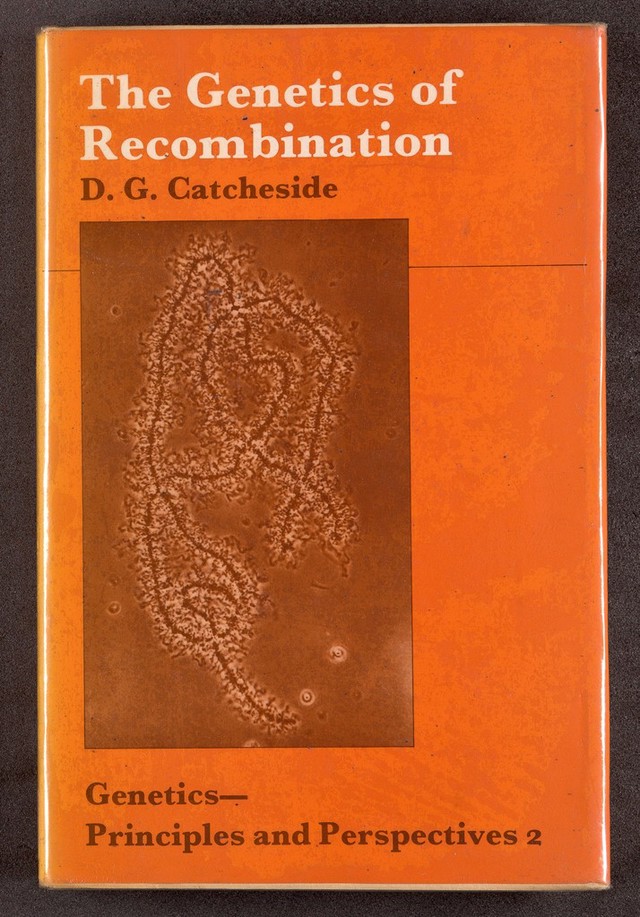
The genetics of recombination / D.G. Catcheside.
- David Guthrie Catcheside
- Date:
- [1977]
Licence: Attribution-NonCommercial 4.0 International (CC BY-NC 4.0)
Credit: The genetics of recombination / D.G. Catcheside. Source: Wellcome Collection.
71/192 page 57
![3.1 Aspergillus nidulans 57 . Four classes of prototrophic recombinant are distinguish- p -]r ni} d able: P-\-D,p+d,p+D and P-\-d. These may be combined with any one of + , + , or m}m}, each in combination with any one of PD, pd, pD and Pd. Thus there are sixteen kinds of genotype for the second chromosome and so 64 possible diploids. The analysis of the diploids that are selected as having a prototrophic phenotype is carried out by selecting haploids from them by growing colonies on a medium contain¬ ing ^-fluorophenylalanine (Lhoas, 1961). The diploids are inhibited and vigorous sectors are dependent on the chance occurrence of recessive mutations that are resistant, so haploid segregates are favoured. The available data are summarized in Table 3.3. Two sets of data, those of Bandiera, Armaleo and Morpurgo (1973) and Morpurgo and Volterra (1968) were not analysed completely. The data of Putrament (1964) provide the most detailed set of pabl'^ allelic recombinants, presumably selected at random and analysed completely. Putrament's (1967) data on pabl'^ and ad9^ are of unique interest. In this case recombination at two linked loci, ad9 and pabl, 0.5cM apart was followed (IcM = 1% of recombination). Remarkably more than twice as many double üí/* pab'^ recombinants were obtained when selection was made for pab'^ (4.12%) as when selection was made for ad'^ (1.78%). Coincidence of recombination in the two loci probably occurs much more frequently than by chance, moreover the ad and pab alleles on the same chromosome convert together. Also, the distal ad and pab sites convert more frequently than do the proximal ad and pab sites. The data show that most recombinants are due to conversion. In Putrament's (1964) data, the doubly mutant was present Withpab^ in only 20 diploids out of 393 diploids studied; some 196 would be expected if all recombinants were reciprocal. The diploid recombinants mostly have the flanking markers from both parental chromosomes (see below) ; homozygosis occurred at the proximal locus in 24 (6.1%) and at the distal locus in 88 (22.4%). The evidence is consistent with most mitotic recombination being due to conversion. Indeed the distribution of flanking markers among prototrophic recombinants is typical of conver¬ sion data. The commonest diploids are P-^Djp^m}d zxid p^d¡Pm}-^D. Even the two recombinant chromosomes, p^D and P^-d, are more](https://iiif.wellcomecollection.org/image/b18025560_0072.JP2/full/800%2C/0/default.jpg)