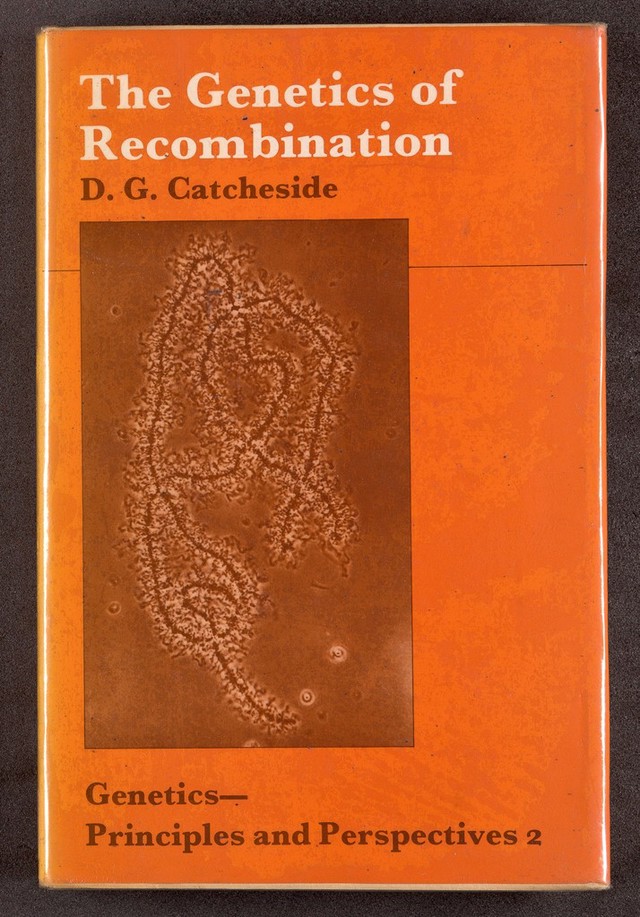
The genetics of recombination / D.G. Catcheside.
- David Guthrie Catcheside
- Date:
- [1977]
Licence: Attribution-NonCommercial 4.0 International (CC BY-NC 4.0)
Credit: The genetics of recombination / D.G. Catcheside. Source: Wellcome Collection.
83/192 page 69
![4.1 Genes of general effect 69 sporulate after some vegetative growth. Sporulation is detected by exposure to iodine vapour, colonies with many asci becoming blue, whereas those not sporulating remain yellow. Confining the selection among the latter to those that show conjugation, some 300 mutants, mostly recessive, were isolated. They belong to 26 complementation groups. These comprised one locus [Jus] showing failure of fusion of haploid nuclei ; three blocked in meiosis I, together with three others all closely linked to the h locus and concerned with commitment to meiosis; one blocked at meiosis II; and 18 blocked at later stages, preventing ascospores being formed around the four haploid nuclei. Esposito and Esposito (1974) have summarized work on conditional mutants defective in sporulation at the restrictive temperature of 34°C. Both récessives and dominants have been isolated, eleven loci having been identified amongst recessive spo mutants. Complementation studies sug¬ gest that genes for 50 functions may be recovered. It is possible that some spo genes are concerned with functions involved in mitosis, a question that could be settled by testing them for allelism to the conditional mutants defective in the cell division cycle described by Hartwell, Culotti and Reid (1970). Four récessives {spo7, 8, 9 and 11) and one dominant {spo98) fail to undergo the pre-meiotic DNA synthesis after induction by acetate medium. Following induction, increased allelic recombination and cross¬ ing over can be detected before the cells are finally committed to meiosis. This property is retained in three mutants {spol, 2 and 3), all of which fail at some stage of meiosis. Thus commitment to recombination, at meiotic frequencies in some intervals at least, does not commit yeast cells to the reductional division of meiosis nor to the doubling of the spindle bodies required for the first division of meiosis. Drosophila melanogaster In Drosophila melanogaster, crossing over is confined to females. A consider¬ able number of mutants, beginning with c(3)G (Gowen, 1933), affecting their meiosis and recombination have been found, chieñy by testing for increased non-disjunction. So far 21 loci have been identified among 37 mutants (27 by deliberate search, 10 by chance) so far enumerated (Sandler and Lindsley, 1974). Mutants affecting the fidelity of meiosis in the male are relatively much rarer, for in tests of magnitude comparable to those that gave 27 female mutants only four male mutants at three loci have been found ; three further loci have been found by chance. The array of effects seen in female meiotic mutants suggests that the genetic controls of meiosis and mitosis differ mainly, at least, in those genes that are concerned with the events specific to meiosis I, namely pairing, crossing over and segregation of homologues. All known meiotic mutants affect only these properties. The arrays observed include: (1) abolition of crossing over and increased non-disjunction at'anaphase I (2 loci, c(3)G and mei-W68) ; (2) decrease of crossing over and increased non-disjunction](https://iiif.wellcomecollection.org/image/b18025560_0084.JP2/full/800%2C/0/default.jpg)