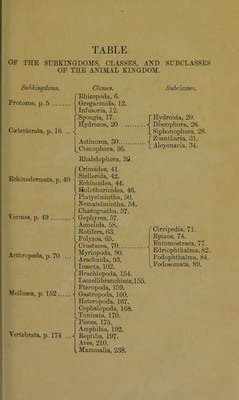
Zoological classification : a handy book of reference with tables of the subkingdoms, classes, orders, etc., of the animal kingdom, their characters and lists of the families and principal genera / [Francis Polkinghorne Pascoe].
- Francis Polkinghorne Pascoe
- Date:
- 1880
Licence: Public Domain Mark
Credit: Zoological classification : a handy book of reference with tables of the subkingdoms, classes, orders, etc., of the animal kingdom, their characters and lists of the families and principal genera / [Francis Polkinghorne Pascoe]. Source: Wellcome Collection.
19/347
![Subkingdom I. PROTOZOA. ACEITA. AMOEPIIOZOA. SAECODEA. PLASTIDOZOA. HYPOZOA. Minute, nearly structureless animals, composed of a gelatinous matter [protoplasm or sarcode], and not developing true layers. Beproduction principally by fission, or by tbe breaking up of the nucleus. The Protozoa differ from the rest of the animal kingdom in that they present no structural elements, or, even if they possess distinct cells, these cells do not develop into tissues. Such tissues as may be found in the higher Infusoria originate, not from the cells, but by changes in the physical and chemical characters. It is, however, undecided whether all Protozoa are unicellular. In Monera there is no nucleus; and it has only been recently \ y t recognized in some of the Foraminifera. In all other Protozoa there is a nucleus [=endoplast, Huxley], In the absence of a nervous system, and in its inherent self- acting power, Bowerbank suggests the hypothesis that the sarcode may be a diffused form of nervous matter. One mode of reproduction is by conjugation (zygosis). Two bodies come together, and a fusion more or less complete takes place. After a time the nucleus breaks up into a number of spores, or the spores are emitted in clouds without any apparent rupture of the surface. Bathybius, supposed to have been a living protoplasmic sub- stance, is now known to be “little more than sulphate of lime precipitated in a floceulent state by strong alcohol.” The classification and even the limits of the Protozoa are still contested ; and the descriptions of these organisms are “ in many instances very contradictory.” It is doubtful whether many of them can be regarded as any thing more than stages in the develop- ment of other animals or of plants. Claus(1876) has two classes •—Ehizopoda and Infusoria—treating the remainder as outside the animal kingdom, and more related to Algae and Fungi. These are Schizomycetes {Bacteria), Myxomycetes (Trichia, Mthalivm); Flagellata {Monas, Volvox, Euc/lena, Pcridium, Noc- tiluca); Catallacta (Magosphcera); Labyrinthulece, apparently related to the Diatomacetn; and Gregarinida. Schmarda (1877) has five classes—Ehizopoda, restricted to Amceboidea, Acinetidte,](https://iiif.wellcomecollection.org/image/b28090688_0019.jp2/full/800%2C/0/default.jpg)