Zoological classification : a handy book of reference with tables of the subkingdoms, classes, orders, etc., of the animal kingdom, their characters and lists of the families and principal genera / [Francis Polkinghorne Pascoe].
- Francis Polkinghorne Pascoe
- Date:
- 1880
Licence: Public Domain Mark
Credit: Zoological classification : a handy book of reference with tables of the subkingdoms, classes, orders, etc., of the animal kingdom, their characters and lists of the families and principal genera / [Francis Polkinghorne Pascoe]. Source: Wellcome Collection.
273/347
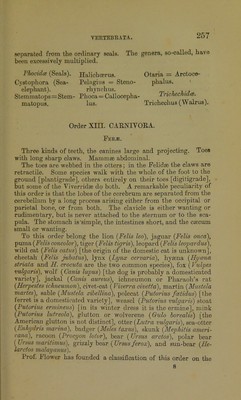
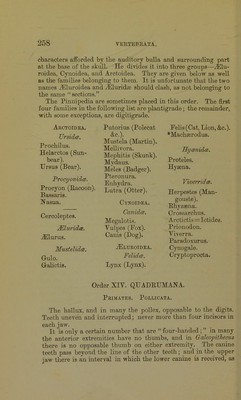
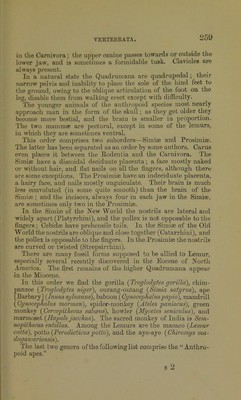
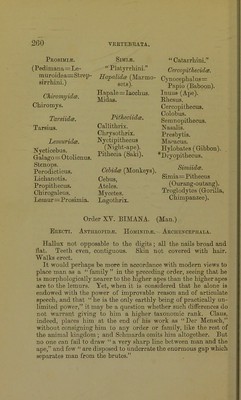
![VERTEIiR.VTA. 25‘J in the Carnivora; the upper canine passes towards or outside the lower jaw, and is sometimes a formidable tusk. Clavicles are always present. In a natural state tlio Quadrumana are quadrupedal; their narrow pelvis and inability to place the sole of the hind feet to tho ground, owing to the oblique articulation of tlio foot on the leg, disable them from walking erect oxeept with difficulty. The younger animals of the anthropoid species most nearly approach man in the form of the skull; as tlley got older they become more bestial, and the brain is smaller in proportion. The two maminse are pectoral, except in some of the lemurs, in which they are sometimes ventral. This order comprises two suborders—Simia; and Prosimite. The latter has been separated as an order by some authors. Carus even places it between the Roden tia and the Carnivora. The Simia; have a discoidal deciduate placenta; a lace mostly naked or without hair, and flat nails on all the fingers, although there are some exceptions. The Prosimise have an indeciduate placenta, a hairy face, and nails mostly unguiculate. Their brain is much less convoluted (in some quite smooth) than the brain of the Simia;; and tbe incisors, always four in each jaw in the Simite, are sometimes only two in the Prosimite. In the Simia; of the New World the nostrils are lateral and widely apart (Platyrrhini), and the pollex is not opposable to the fingers; Cebidte have prehensile tails. In the Si mite of the Old World the nostrils are oblique and close together (Oatarrhini), and the pollex is opposable to the fingers. In the Prosimite the nostrils are curved or twisted (Strepsirrhim). There are many fossil forms supposed to be allied to Lemur, especially several recently discovered in the Eocene of North America. The first remains of the higher Quadrumana appear in the Miocene. In this order we find the gorilla (Troglodytes gorilla), chim- fianzee (Troglodytes niger), ourang-outang (Simia satyrus), ape Barbary] (Inuussylvanus), baboon (Cynocephaluspapio), mandrill (Cynocephalus mormon), spider-monkey (Aides paniscus), green monkey (Cercopithecus sabcsus), howler (Mycctes seniculm), and marmoset (Hap ale jacohus). The sacred monkey of India is Sem- nopithecus entdlus. Among the Lemurs are the macaco (Lemur catta), potto (Perodicticus potto), and the aye-aye (Chiromys ma- dagascariensis). The last two genera of the following list comprise the “Anthro- poid apes.” s 2](https://iiif.wellcomecollection.org/image/b28090688_0273.jp2/full/800%2C/0/default.jpg)