Zoological classification : a handy book of reference with tables of the subkingdoms, classes, orders, etc., of the animal kingdom, their characters and lists of the families and principal genera / [Francis Polkinghorne Pascoe].
- Francis Polkinghorne Pascoe
- Date:
- 1880
Licence: Public Domain Mark
Credit: Zoological classification : a handy book of reference with tables of the subkingdoms, classes, orders, etc., of the animal kingdom, their characters and lists of the families and principal genera / [Francis Polkinghorne Pascoe]. Source: Wellcome Collection.
43/347
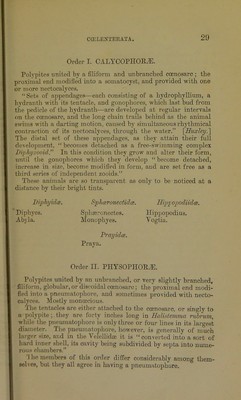
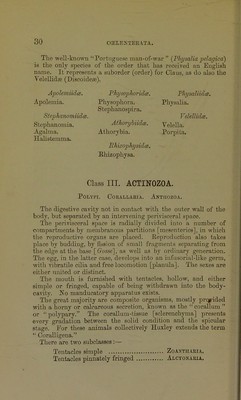
![Order I. CALYCOPIIORyE. Polypites united by a filiform and unbranched ccenosarc ; the proximal end modified into a somatocyst, and provided with one or more nectocalyces. “ Sets of appendages—each consisting of a hydrophyllium, a hydranth with its tentacle, and gonophores, which last bud from the pedicle of the hydranth—are developed at regular intervals on the ccenosarc, and the long chain trails behind as the animal swims with a darting motion, caused by simultaneous rhythmical contraction of its nectocalyces, through the water.” [Huxley.] The distal set of these appendages, as they attain their full development, “becomes detached as a free-swimming complex Diphyzooid. In this condition they grow and alter their form, until the gonophores which they develop “ become detached, increase in size, become modified in form, and are set free as a third series of independent zooids.” These animals are so transparent as only to be noticed at a distance by their bright tints. Diphyidce. Splicer onectidce. Hipp opodiidce. Diphyes. Spliasronectes. llippopodius. A by la. Monophyes. Vogtia. Prayidce. Praya. Order II. PIIYSOPIIORE. Polypites united by an unbranclied, or very slightly branched, filiform, globular, or discoidal ccenosarc; the proximal end modi- fied into a pneumatophore, and sometimes provided with necto- calyces. Mostly monoecious. The tentacles are either attached to the coenosarc, or singly to a polypite; they are forty inches long in Halistemma rubrum, while the pneumatophore is only three or four lines in its largest diameter. The pneumatophore, however, is generally of much larger size, and in the Velellidaj it is “ converted into a sort of hard inner shell, its cavity being subdivided by septa into nume- rous chambers.” I he members of this order differ considerably among them- selves, but they all agree in having a pneumatophore.](https://iiif.wellcomecollection.org/image/b28090688_0043.jp2/full/800%2C/0/default.jpg)